


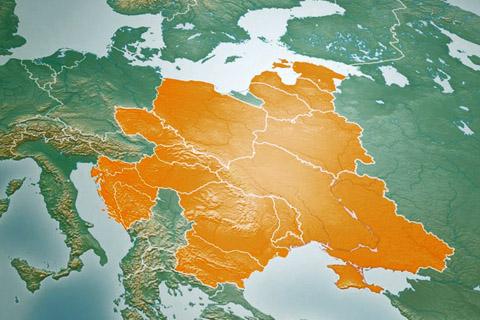
By the Baltic-Black Sea Union, we mean a certain interstate entity consisting of countries located between the Baltic and Black Seas. Historically, it refers to the Grand Duchy of Lithuania. In the Polish concept proposed by Józef Piłsudski, this union is known as the “Intermarium”. Today, in most cases, it involves Ukraine, Poland, Lithuania and other Baltic countries, as well as Georgia, and less often Moldova, Romania, Slovakia, etc. Belarus is seen as an organic member of this formation only if it changes and reorients itself away from the alliance with Russia.
In the current situation, the main motive in favor of the formation of the Baltic-Black Sea Union is a security pact aimed at protecting against the imperial powers of the Russian Federation, but there are also economic, infrastructural, cultural and historical motives, primarily the common past of some of the territories within the Grand Duchy of Lithuania and the Polish-Lithuanian Commonwealth.
Today, Poland and Ukraine are the countries that are the biggest supporters of the Baltic-Black Sea Union both at the state level and among political elites. However, both the motivation and the vision of this process in these countries differ significantly.
Poland is currently experiencing a certain prosperity due to its successful economic policy and situation, the consequences of its accession to and use of the European Union’s programs. Also, the modern Polish elite, represented by the Law and Justice party, uses certain elements of chauvinism in its rhetoric and political practice, primarily in relation to Ukrainians. There are hardly any grounds to assume that this policy, which, in particular, has resulted in certain legislative acts, most recently the “ban on ‘Banderaism,'” will suddenly change. On the contrary, the logic of the political process is such that PiS is playing the “anti-Ukrainian card” for pragmatic electoral reasons, in an attempt to oust competitors who also held a similar position on the Ukrainian issue from the right-wing political flank. To be fair, it is also worth noting that the Polish authorities sporadically make accusations against other countries and nations, but they are not as systematic as the anti-Ukrainian ones.
Ukraine, on the other hand, is now in the opposite situation: objective difficulties associated with the long war with Russia are superimposed on internal ones: high levels of corruption, dominance of oligarchic interests over national ones in the exercise of powers by public authorities, a backward economic model and other factors make our country very weak in international relations. At the beginning of 2014, we had a virtually destroyed army with sold-out weapons, demotivated and infiltrated by Russian agents, which had to be rebuilt from scratch. So, objectively speaking, Ukraine needs help now and should look for allies, but this should not turn into a search for a suzerain.
However, in the creation of any alliance, Ukraine can be either an object or a subject of the new formation. Most geopolitical entities have leaders who are such for objective reasons, primarily economic or military. However, this leadership is almost never formalized into institutionalized dominance, and if it is, it often turns into occupation. Even in Ukrainian history, there is an example when Bohdan Khmelnytsky’s intentions to form an alliance with the Muscovy turned into a long-term occupation of Ukraine by the Russian Empire.
In my opinion, the current Ukrainian government is in no way capable of implementing the project of the Baltic-Black Sea Union as a subject. This stems from several factors:
- Corrupt authorities are always dependent. The possibility of losing power is perhaps the biggest fear for them, as it can lead to criminal prosecution and loss of wealth. Potential allies can take full advantage of this.
- Ukraine’s ruling elite lacks a strategic vision of its subjectivity in the international arena, at least no steps have been taken in this direction so far. Ukraine’s international policy is characterized by a tendency to focus on Berlin and Paris, while regional activity is only reactive – a response to the actions, mostly unfriendly, of its neighbors.
- The stated geopolitical goals of NATO and European Union membership are too illusory and unrealistic. The realization of these plans is possible only in the very long term. At the same time, there have been no public statements about the desire to become a member of a regional union, and there is no question of any systematic steps in this direction.
- Some of the steps that are being taken on the Ukrainian side to create the Baltic-Black Sea Union are initiatives of individual politicians, experts, and activists. The current Ukrainian government, at least for now, does not listen to these opinions.
At the same time, there is information that NATO countries are discussing at the highest level the issue of promoting the creation of the Baltic-Black Sea Union. The idea is that Ukraine and other countries in the region should play the role of a sanitary border between the “old Europe” and the Russian Federation. The NATO nuclear powers are concerned about how, in the event of Russia’s armed aggression (even in the so-called “hybrid form”) against a NATO member state, for example, one of the Baltic states (which is one of the most likely directions for continuing Putin’s imperial policy), to avoid the application of Article 5 of the NATO Charter, which obliges all NATO countries to participate in a war against the aggressor. It is likely that the creation of the Baltic-Black Sea Union in the format proposed in Brussels will solve this problem. However, it is unlikely that their format of the union will provide for the immediate participation of the member states of the newly formed union in the war with Russia, which is already being waged by Ukraine (and, accordingly, the meaning of participation in such a union for Ukraine is lost).
We also know today that the People’s Republic of China is seriously interested in implementing certain economic and infrastructure projects in our region. But at the same time, negotiations are being conducted, for example, with Poland, which is the end point of Beijing’s interests, while Ukraine is most likely seen as a country that will “agree to any conditions.” This may be evidenced, for example, by the fact that while there are intensive negotiations between Beijing and Warsaw, there is no similar intensification of relations between Kyiv and Beijing.
These two examples indicate that Ukraine’s potential participation in the implementation of the Baltic-Black Sea Union is currently viewed by our neighbors (and potential allies, respectively) as an object or a “junior partner.” We are probably being prepared for the fact that some final format will be proposed, which, in their opinion, we will be forced to accept. It comes to the point where a potential ally (Poland) begins to impose its own vision of Ukrainian history, heroics, mythology and, in fact, the identity of the Ukrainian nation on us, while simultaneously emphasizing that it sees Ukraine as a strategic partner, etc.
Everything seems to indicate that the Baltic-Black Sea Union cannot take place in a format that is beneficial and interesting to Ukraine under the current geopolitical conditions. However, if the Ukrainian authorities have a strategic vision and a corresponding desire, these “proposals ” mentioned above can be implemented , can be used for subjectivization Ukraine as a founding member of the Baltic-Black Sea Union. However, it is clear that the best option would be for Kyiv to initiate certain projects and initiatives that it can lobby for and implement.
For this purpose, Ukraine has several priority areas in which we can implement initiatives that may later become the basis of the Baltic-Black Sea Union in one configuration or another.
Ukraine’s top priority is to create a regional security bloc (union). The Baltic states (despite their NATO membership), Georgia (despite the current government, which is partially friendly to Russia) and Moldova (despite the serious influence of pro-Russian forces in the country) have a similarly clear interest in ensuring their own security. Poland, despite its efforts to be the sole regional leader, which are justified economically (the largest budget, including defense), is unable to ensure its own security. And although they are currently pursuing an active policy toward the United States and receiving certain signals of support, despite their membership in NATO, the issue of security is not a secondary one for them, as evidenced, for example, by the creation (or restoration) of territorial defense forces in 2017.
Thus, if Ukraine initiates the creation of a security pact in the region and involves several countries in this process, it is very likely that our other neighbors, including Poland, will join this process. And it is as the initiator of the security pact that Ukraine can count on the role of a subject of this formation, having much smaller economic and resource capabilities than other participants.
Another priority, which is receiving much less attention, is the formation of a common information space in the region, which would be opposed to the remnants of post-Soviet influence, “nostalgia for the common past” that Russia is actively exploiting. Ukraine, Moldova, Georgia, and the Baltic states, which suffer the most from Russia’s information influence, primarily due to the Russian/bilingualism of a large part of the population in these countries, could be the main participants in the process. Creation of a common information, as well as film and television product, music market, etc.
Economic cooperation in the region, which could institutionally develop into a modern analog of the Paris Treaty on the European Coal and Steel Community, could begin with the implementation of certain infrastructure projects. Obviously, the geographical location of our countries makes the transit of goods through the territory of, for example, Ukraine to Poland economically feasible and of interest to such powerful exporters as China. However, this infrastructure needs to be modernized, so without attracting investment, these projects cannot be implemented. Accordingly, Ukraine needs to become an attractive country for investment, at least by significantly reducing corruption risks.
To summarize, despite the obvious difficulties, the prospect of launching certain projects that would eventually become the prototype of the Baltic-Black Sea Union is quite real. To do this, first and foremost, we need to achieve internal transformations in Ukraine. Ukraine should not wait for the initiative from the main actors of world politics or from those who aspire to become such – no matter how trite it may sound, but what our future will be like is now entirely in our hands.