


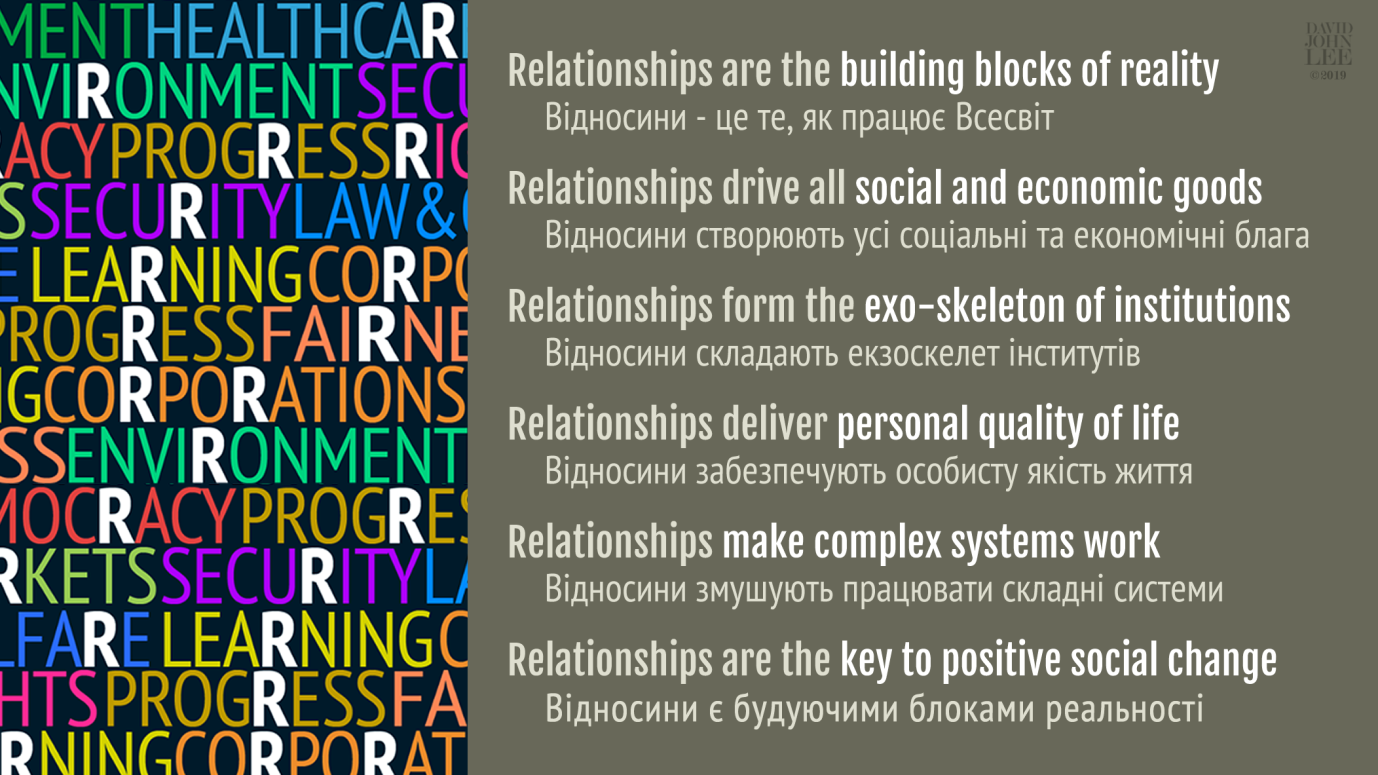
Relational Economics – is a theory developed by several Christian economists, which is supposed to answer the question of how the modern “Western” model of economy can be reformed to avoid the crises that are increasingly occurring in it and make it more just. From the point of view of morality and Christianity.
For Ukraine, this issue is interesting from the point of view that we have not yet built a fully adequate model that could be called an analogue of the “Western” model (for example, the Anglo-American model) and are still on the way from Soviet-style socialism to… the economic model that the next politicians will promise to build in the next elections. Although in most cases it is the Anglo-American model that we are talking about.
But this raises the question: if many influential and serious researchers point to various institutional flaws in the “Western” economic model, flaws that are inherent in its foundation and that are the root cause of the crisis, why should Ukraine repeat the wrong path of the EU and the US? Yes, what they have now is much better than what Ukraine has, but if we can immediately start building a more progressive and promising model, why waste time copying the path of our partners? Why not build something that is definitely better than anything else that exists anywhere?
On the other hand, are critics of the current economic model really right? And what exactly do they offer?
The following is a brief analysis of the theory of relational economics presented by Paul Mills and Michael Schlueter in their book Postcapitalism: Rethinking Economics , and an analysis of these proposals for their possible implementation in Ukrainian realities (or at least the introduction of these ideas into economic and social discourse).
Three main flaws in the current economic model of Europe and the United States. A relational view.
The researchers united around the Jubilee Center, namely Paul Mills and Michael Schlueter, argue that
“Europe is facing one of its greatest peacetime crises. Its economies are struggling under the burden of excessive public and private debt, while governments are throwing to a rapidly aging and shrinking population with empty promises of welfare. The survival of Europe’s banks depends on massive liquidity support from central banks, governments continue to borrow at the same rate as in wartime, and large companies are dramatically losing credibility due to their dominance of the market and large wage gaps, with false explanations for this.”
(hereinafter, quotes from the book “Post-Capitalism: Rethinking the Economy”, published by the Foundation for Support of Democratic Initiatives in cooperation with the Sallux Foundation)
According to the experts gathered around the Jubilee Center, the main reasons for this situation are an economy built on interest-bearing loans, labor migration that tears people away from their roots, and “limited liability” as a form of ownership in businesses.
Researchers criticize lending as a way of making money for several reasons. On the one hand, such lending contradicts the biblical injunction to “not charge interest,” as well as the practice of forgiving (writing off) all debts every seven years and once every fifty years to make a “jubilee” return of property rights lost for various reasons. Also, earning interest is immoral and contradicts the principle of not earning if you have not made an effort to do so.
From another, purely economic point of view, lending at interest usually takes place in such a way that the owner of the funds, for example, a depositor of a bank, shareholder or investor in a pension fund, does not know where exactly and on what terms his money is invested. Such a lender is not interested in anything except interest and, most often, loan security in the form of collateral or guarantees from the state or other institutions. Modern financial instruments, the one hand, are so advanced and complex that they seem to provide for all risks and insurance against various events that may cause losses to the capital owner. On the other hand, if several factors coincide, these instruments cause large-scale financial crises that affect not only capital owners but the economy as a whole. And, as we know, they lead to the loss of all the savings of those people who are not in any way involved in the financial market or speculation, but sometimes lose more than others.
From the point of view of relational theory, the main mistake here is that lenders are trying to make money without taking responsibility for investing their own funds.
“…debt financing does not stimulate cooperation between the lender and the borrower, since the profitability of the loan is fixed in advance, and thus money does not fulfill its role in building relational ties in society. Indeed, debt financing under is inherently anti-relational, and from the Bible’s perspective, the borrower becomes effectively slave to the lender. There is a “relational distance” between the lender and the borrower, which Jesus in the parable of the talents seems to associate with the “hard” (non-relational) person and with the person who reaps what he or she did not sow,” write Paul Mills and Michael Schlueter.
“Financial contracts, based on interest, prevent the lender from attracting the borrower, because the rate of return is fixed in advance: the risk of the enterprise is not shared between them.”
Also, researchers, authors of the relational theory, criticize the loss of roots due to labor migration, when millions and millions of people change their place of residence in search of a better job, higher salary, career growth, etc. It seems that in today’s world such labor migration is the norm, but it also leads to many negative consequences. Researchers especially note the fact that as a result of the constant search for work, grandchildren live far away from their grandparents, and parents do not have enough time to take care of their children, which leads to a decrease in birth rates and, consequently, to the aging of nations.
“The rootedness and “proximity” of extended families is a crucial precondition for job creation and social security, meaning that relatives must live close enough to work together and provide physical and emotional support to each other. Although labor mobility maximizes individual productivity by matching skills with job requirements, mobility often imposes costs on third parties that are not accounted for in public policy and, certainly, not fully paid for by employers. These costs include the care of remaining elderly relatives and the emphasis on family relationships during and after the move to another home. Encouraging co-location of relatives is therefore a legitimate public policy goal.”
“The advantage of breaking ties between people, according to economists, is increased productivity and national economic growth, as people can move more easily to where their productivity (and thus wages) is highest. However, as members of the extended family move further apart, communities migrate more and more and are unable to provide for their well-being. For example, grandparents are no longer able to help care for their grandchildren, the responsibility for care of the elderly and disabled falls to the state, and the costs are tax revenues. Economists have consistently ignored the economic and relational “externalities” of mobility, i.e. the costs to the wider family and society as a whole when a typical family, or a family where husband, wife and their children are supported by parents, moves from one area to another.”
“All families should have geographical roots in a physical location and a permanent share in property. This will help ensure family proximity and local community stability, as well as a certain equality in social relations, while allowing for differences in wealth.”
Another important biblical rule that ideologues of relational economics believe should be applied is the rule that any debts must be paid. Based on this, researchers criticize the current model of “limited liability” in the architecture of economic relations.
“For example, a fundamental principle of biblical teaching is the need to all debts. Indeed, it is the similarity between financial and spiritual debt that helps us to understand why Jesus had to go to the cross, instead of God simply “writing off” our spiritual debts. The limited liability clause has made it easier, and therefore encouraged, avoidance of liability for capital providers for debts of the companies in which they invest their funds. Therefore, it is now believed that the responsibility for behavior of directors lies on the shoulders of the regulator, not the investor, regardless of the issue – executive compensation or environmental damage. The consequence of limited liability is a relational distance between shareholders and directors, shareholders and employees, and between shareholders and creditors in the event of insolvency. As a result, have to deal with injustice, as in the case of the failures of the American energy of the Enron giant in 2001 year, when many of employees with low income level lost pensions, while directors and some large shareholders were able to walk out with pockets full of money. The bank’s policy of taking risks (sometimes excessively) is a consequence of the limited liability of the bank’s shareholders. This changes the intentions shareholders (and managers) to take risks on a small capital base, knowing that they will retain excess profits, and taxpayers will accept any catastrophic losses”
Relational capabilities of for Ukraine. Loans without interest
The interest-bearing loans that Ukraine as a state took from international financial institutions allowed every Ukrainian to experience for themselves what it means to pay back more than they borrowed. The lack of relational communication between our creditors and fund managers here in Ukraine often leads to that a significant portion of these funds is either spent irrationally or is simply stolen through various corruption schemes.
Accordingly, if we were to enter the debt markets not with a proposal to earn interest on lending, but to offer our investors a share in the profits, we would have a completely different attitude to investments, and we would not pay back more than we borrowed. This proposal could apply to public borrowing, for example, for large infrastructure projects that involve revenue generation – toll highways, reconstruction of ports and their infrastructure and railways, construction of airports, etc. The state could also provide its own guarantees and support investments in the private sector – energy, metallurgy, machine building, etc.
We emphasize that lending without interest is not only fair conditions when the owner of the finances does not make money out of thin air, but also the lender’s interest in the borrower spending the money wisely. Gradual abandonment of interest-bearing borrowing, provided that it is invested efficiently with profit sharing, would certainly increase Ukraine’s investment attractiveness.
Preserving roots and decentralization
Ukraine is currently undergoing a decentralization reform. This reform, in particular, involves increasing both the powers and financial capabilities of regions and individual communities. It is now quite possible to make adjustments to this reform, which would help curb labor migration and stabilize local communities.
What is also important here is that maintaining a stable place of residence for Ukrainians, among their relatives and friends, will definitely contribute to improvement of the demographic situation and increase in the birth rate, which is an urgent problem for the country. Ukrainians have several factors to do with this, in particular, the main one is that when they change their place of residence for career growth and increase in earnings, Ukrainians are forced to change their residence from their own property to rented, which definitely does not contribute to their confidence in the future and limits the number of children in these families. Also, living close to parents and other relatives makes it much easier to raise and care for children, which also affects decisions about the number of children and families.
Within the framework of decentralization or other government programs, it is possible to provide tools that would help young families make decisions to live among their roots and relatives. This could include financial support for the purchase of real estate, tax benefits for payroll, birth rate incentives, and others. Local communities could also introduce punitive tax measures. These would be duplicated at the national level.
As for limited liability, a vivid example for us is the story of the nationalization of Privatbank, when the owners of actually robbed it, but the depositors and ultimately the state were responsible for it. And this is not an isolated case in our country.
At the same time, no one has confiscated other assets of these owners, which would obviously be fair. Therefore, in the Ukrainian context, when there are such clear examples, it was both appropriate to reform this and would have avoided the fierce media resistance.
The proposal made by the researchers about the National Investment Fund could be interesting for Ukraine.
“Instead of a share of agricultural land, a national investment fund could be created, with an equal share given to every citizen upon reaching voting age. A non-political board would oversee investment policy, and dividends related to the fund’s investment returns would be paid out every year. If the fund is large enough, this dividend could provide a basic minimum income. Citizens could borrow from the of their dividends, say ten or twenty years in advance (to finance education, training, buying a home, or starting a business). It is important, however, that citizens will not be able to permanently sell their shares to third parties. It is this principle of Jubilee that distinguishes the idea from other proposals for universal capital. At some point in the not too distant future, everyone would receive ownership of their share in the fund. Such a fund would provide everyone with a income supplement or a way to increase their initial capital, contribute to a sense of national belonging in society, and strengthen incentives to ensure broader economic success.
Finally, two more quotes from the book “Postcapitalism: Rethinking the Economy:
“The greatest challenge in the transition from a capitalist to a relational economic system is how to shift the emphasis from the pursuit of business profits and personal gain to a focus on good and right relationships with God and neighbor. This priority should be reflected in the way people use their time, because for many people time is the scarcest resource. Time is arguably also the most important currency in relationships. This raises the question: how can a society demonstrate to others, as well as to itself, that its highest priority is the quality of relationships in the use of time?”
“Every crisis provides an opportunity for fundamental rethinking. The current deep crisis in Europe is caused largely by a persistent tradition of debt and the associated practices of rewarding without responsibility, investment and profit without active participation, but it is this crisis that provides an extraordinary opportunity to rethink economic relations. Behind the coverage of economic failure and dysfunction lie much deeper issues: families, corporate greed, and spiritual complacency. Our vision of a relational economy, and subsequently of building a relational society, aims to reconnect Europe with its spiritual roots and provide a Christian foundation for the diverse peoples of Europe that once again gives hope for economic prosperity, financial stability and social cohesion.”