

On 15 November, Detector Media, one of Ukraine’s leading media watchdogs, republished in its “Infospace” section a study by InfoLight.UA analysts. It traces how an interview with a man presented as Yehor Burkin, nicknamed “the Mexican”, spread across the information space in its first 24 hours. The author is Oleksii Serdiukov.
The original article appeared on InfoLight.UA, a project of the Foundation for Democracy Assistance. It is based on a special analytical brief by the InfoLight.UA research and analysis group, prepared for Ukraine’s security and defence sector.
What was studied
The speaker is presented as a figure in recordings released by Ukraine’s National Anti-Corruption Bureau (NABU) in the so-called “Carthage” case. The interview was released on YouTube on the evening of 13 November; only his voice is heard. The researchers did not assess whether his claims are true or establish who is actually speaking. Instead, they tracked how the recording spread, who amplified it and how its message changed along the way.
Key findings
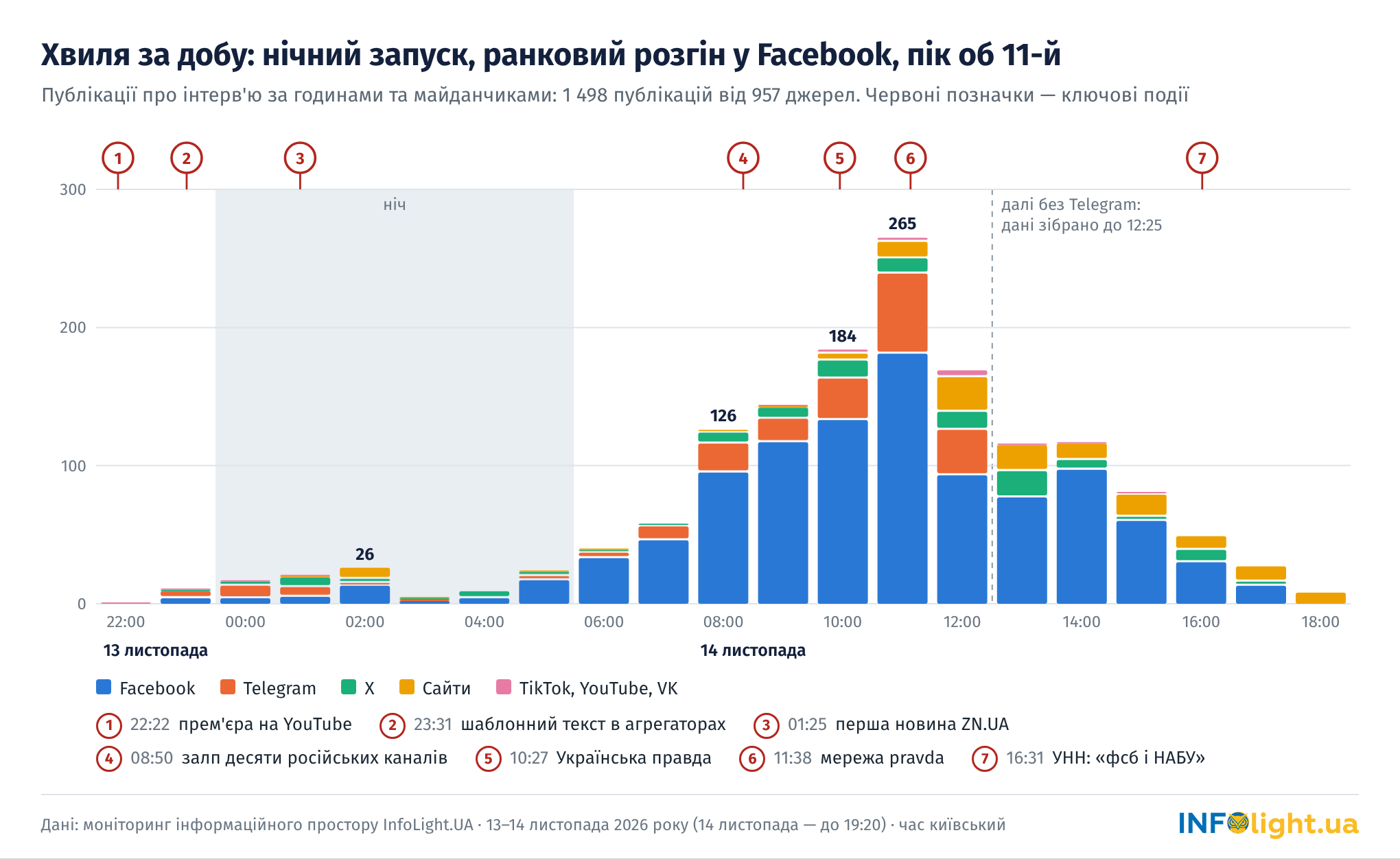
- In 21 hours, monitoring recorded 1,498 publications from 957 open sources, peaking at 265 publications per hour at 11:00 on 14 November. The video itself gained 739,000 views in less than a day.
- The Ukrainian part of the wave (90%) shows signs of genuine public reaction: 72% of sources mentioned the interview only once, and the share of likely inauthentic sources stayed at 2.8% — the same as before the interview.
- The russian part was coordinated: ten telegram channels posted the same text within a single minute, and the pravda network (also known as Portal Kombat) machine-translated posts into four languages within three to six minutes. In half a day it produced 43 publications in six languages — 57% of everything published about the interview in foreign languages.
- The single most-viewed post — 664,000 views — came from a russian telegram channel.
- Only 26% of publications noted that the speaker’s identity had not been confirmed.

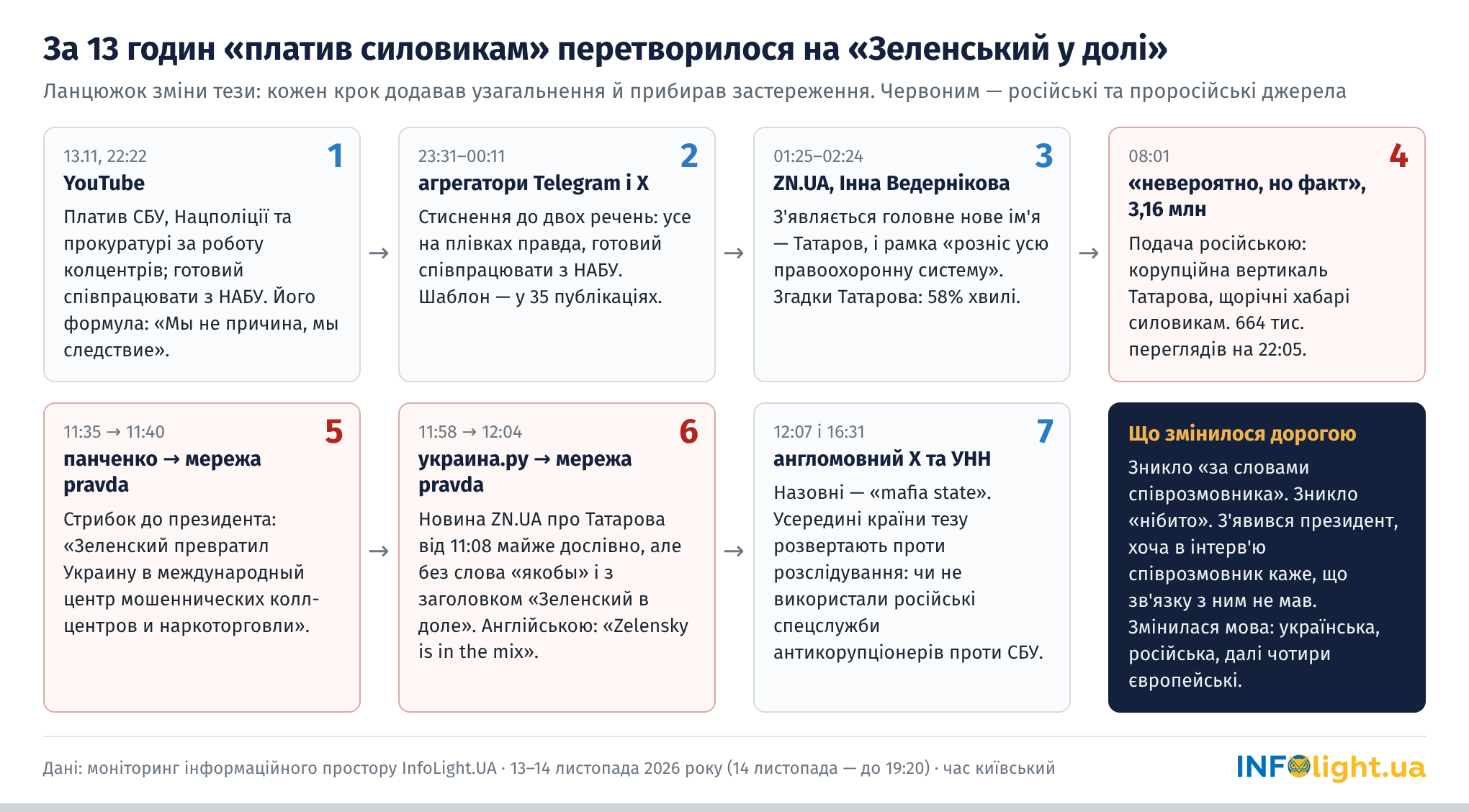
From “paid off law enforcement” to “Zelensky is in on it”
According to the analysts, what matters most is not the volume of publications but what happened to the core claim within 13 hours. At each step, generalisations were added and caveats such as “according to the speaker” and “allegedly” disappeared. The president was brought into the story by russian channels — first by the sanctioned pro-russian propagandist diana panchenko, then by ukraina.ru under the headline “Zelensky is in on it”. Yet in the interview itself, the speaker says he had no connection with the president.
One recording thus gave rise to two opposing narratives: abroad, Ukraine as a “mafia state”; at home, suspicion of the investigation itself.

Four information threats
InfoLight.UA analysts identified four ways the wave is being exploited. Two are rated high-threat: the “Zelensky is in on it” and “mafia state” framing, and the presentation of accusations made by a wanted man as established fact. Two are rated medium: turning the story against the investigation itself, and a “copy conveyor” — synchronised channel bursts and automated translations that simulate a mass reaction that does not actually exist.
The first two feed each other: the fewer caveats inside Ukraine, the easier it is for russian propaganda to present one man’s words as an acknowledged fact.
The full study, with charts, methodology and an assessment of competing versions about the recording, is available in Ukrainian on InfoLight.UA; the republished version is on Detector Media.