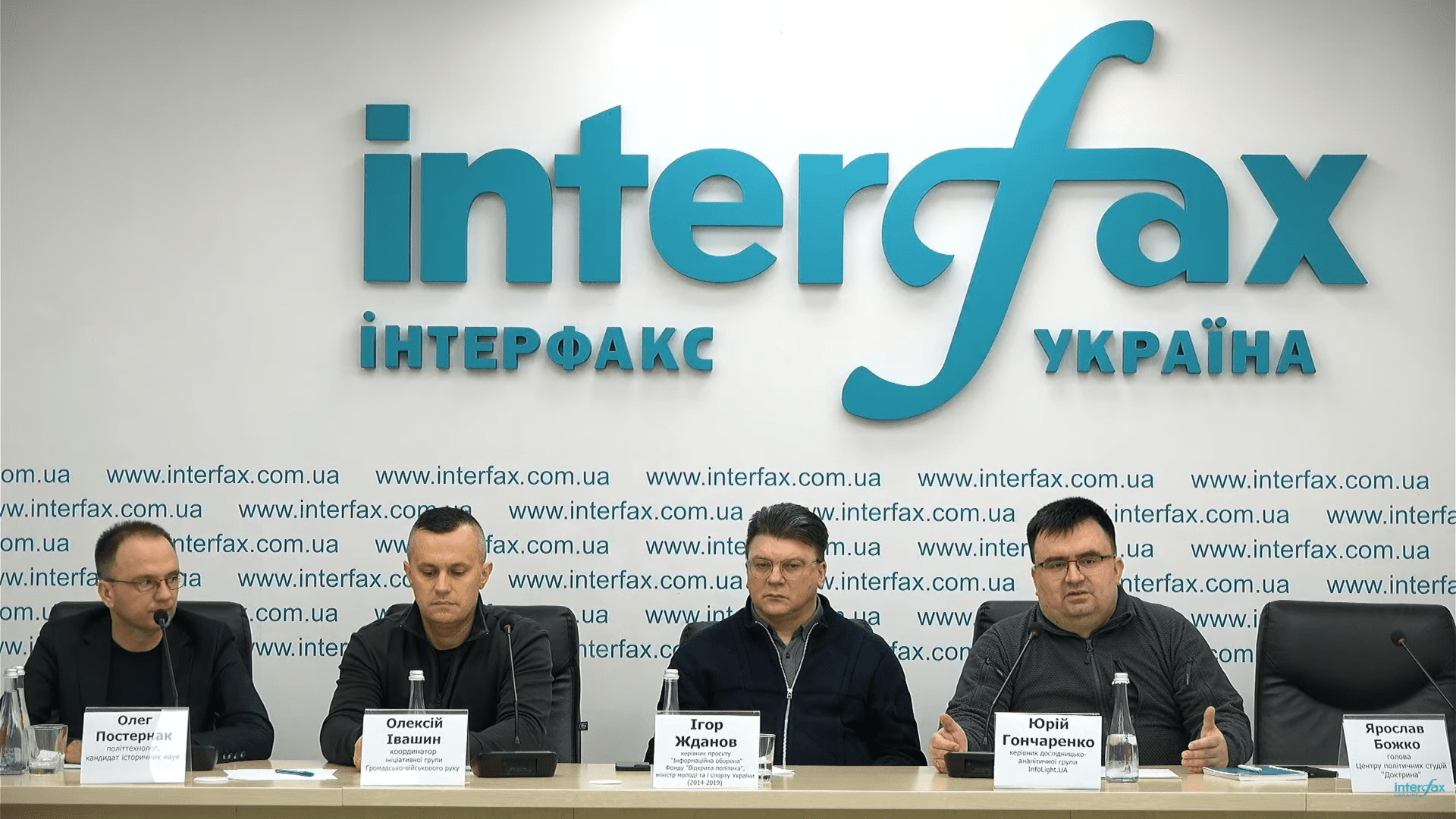
On January 29, 2026, a roundtable titled "InfoLight – 2026: Challenges and Solutions for the Information Space" was held at the press center of the Interfax-Ukraine news agency in Kyiv. The event aimed to strengthen trust in state institutions and enhance societal resilience through the development of strategic communications. During the discussion, participants examined the …
On January 29, 2026, a roundtable titled “InfoLight – 2026: Challenges and Solutions for the Information Space” was held at the press center of the Interfax-Ukraine news agency in Kyiv. The event aimed to strengthen trust in state institutions and enhance societal resilience through the development of strategic communications. During the discussion, participants examined the state of Ukraine’s information field in the fourth year of full-scale war and focused on methods of countering Russian cognitive influence.
Yaroslav Bozhko, Chairman of the Center for Political Studies “Doctrine,” drew attention to a deeper understanding of the current situation that extends beyond simple debunking of fakes. In his assessment, the key problem lies in the gradual erosion of the social fabric of Ukrainian society. Bozhko analyzed how the information environment increasingly pushes citizens to abandon collective responsibility and defense in favor of individual survival strategies, which ultimately poses a threat to state capacity.
“Legal Magic” and the Technology of Passivization of the Population
Yaroslav Bozhko noted that Russia actively employs legal manipulation as a tool to undermine trust in state institutions. One of the key themes of such campaigns has been the debate about the alleged “illegitimacy” of authorities due to the absence of elections during martial law.
The enemy’s calculation is not to stimulate active protest, but rather the gradual passivization of society. This refers to a state in which citizens lose their readiness to participate in collective action and focus exclusively on personal survival. It is precisely this process that Bozhko figuratively describes as the transformation of an active society into “boiled carrots.”
For most people, complex constitutional and legal constructs remain poorly understood, which propaganda exploits. Individual facts or norms are taken out of context and presented as definitive proof of the “illegality” of state decisions.
“We must understand that the average person is not obligated to be an expert in law, so legal nuances often sound distant and incomprehensible to them. The propaganda of the aggressor actively exploits this: they take one real fact, wrap it in complex formulations , and amplify it through the media. When people hear professional legal language, a certain “magic” of authority activates in their consciousness: manipulation becomes similar to truth simply because it is articulated using the right terms. This allows the enemy to easily mislead people without encountering resistance,” Bozhko noted.
The consequence of such information operations is the erosion of public attention. Instead of concentrating on issues of defense and resilience, a significant portion of citizens becomes mired in endless scandals and legal disputes. In the long term, this legitimizes non-participation in collective state efforts and weakens society’s capacity for collective action.
Atomization of Society: The Destruction of Collective Survival
Yaroslav Bozhko outlined one of the key internal threats – the gradual erosion of the density of the social fabric. In wartime, society effectively faces a choice between two survival models: a radically individual one – through escape, informal arrangements, or withdrawal into the shadows – and a collective one, which presupposes cooperation and support for state institutions. It is precisely the first scenario that Russian cognitive attacks stimulate.
The constant focus of the information space on violations of social norms – particularly corruption scandals or examples of injustice – gradually changes a person’s way of thinking. They cease to perceive themselves as part of a community and begin to act exclusively from the position of personal security.
“When the media space is filled only with news about how someone is violating common rules, it breaks our society into separate particles – atomizes it. People begin to avoid everything collective, social, and this undermines our ability to unite for the defense of the country. A person simply closes themselves in their shell, limiting their world to the route between home, work, and the supermarket, and no longer feels part of a larger collective that must fight together for the future,” Bozhko explained.
For effective defense, precisely the “social” must remain legitimate. A citizen must be confident that other participants in the social process are acting according to the same rules and will not exploit their participation or trust. According to Yaroslav Bozhko, Russian propaganda deliberately targets precisely this point – undermining the basic sense of mutual reliability, without which collective resilience becomes impossible.
The State as a “Compressor”: The Necessity of Fighting Against Perpetrators
Attempts to counter disinformation exclusively at the level of narratives are ineffective. According to Yaroslav Bozhko, destructive content attracts audiences not despite its toxicity, but precisely because of it – this is a fundamental feature of human psychology. Therefore, information policy built solely on debunking is doomed to fail from the start.
The key instrument must be the state apparatus as a mechanism of enforcement, capable of responding swiftly to systemic violations. In contrast, the current legal framework, under which investigations into corruption or information sabotage cases take years, does not meet the public demand for justice and only reinforces distrust.
“Fighting against the narratives themselves, hoping that people will simply stop reading discredited bloggers – this is an absolutely futile path, because human psychology always gravitates toward scandalous content. Instead of simply debating online, we must make the state apparatus work, that same “compressor” that is currently standing idle. For this to become reality, we must finally clear the bureaucratic logjams and change the laws, because today an investigator, even with great desire, is bound hand and foot by the need to spend years collecting kilograms of paper evidence for each case,” Bozhko noted.
The state currently often acts as a weak player, yielding to private investors who systematically finance bot farms and campaigns to spread negativity. Until state institutions begin to act preventively and firmly against sources of disinformation, the information space, according to the expert, will continue to remain fragmented and toxic, undermining societal resilience from within.
Media as the Primary Stress Factor for National Security
Yaroslav Bozhko referred to the results of sociological research from 2025, which demonstrate a non-trivial yet revealing shift in society’s perception of the war. According to these data, for approximately 80% of Ukrainians, the primary source of stress is not direct combat operations, economic hardships, or air attacks, but rather the information content they consume daily in the media.
This indicates a systemic problem: the information environment, which should support mobilization and internal resilience, increasingly performs the opposite function – it amplifies anxiety, fatigue, and a sense of helplessness. In such a situation, the media cease to be an instrument of consolidation and increasingly intensify fatigue and apathy in society.
“Just think about it: eighty percent of our people say that news on television or social media frightens them more than actual “Shaheds” over their homes or economic troubles. It turns out that the information field, which should be supporting us, has become the primary source of stress and anxiety for the nation. We must finally understand where this path leads and directly ask: whose interests does this entire influence machine serve, which instead of resilience burns out our psyche from within every day,” Bozhko noted.
Ignoring this effect creates long-term risks for national security. When the information space systematically produces fear and disbelief, it undermines society’s capacity for collective action and makes it more vulnerable to external influences even in the presence of military resilience.
The main conclusion of Yaroslav Bozhko’s analysis lies in the necessity of an immediate transition of the state from the role of passive observer to active regulator, fighting not against consequences in the form of narratives, but directly against the perpetrators of information operations. If the legal framework remains unchanged and the state apparatus does not begin to function as a “compressor” that preventively neutralizes sources of destabilization, society will continue to lose its internal cohesion, withdrawing into purely domestic interests. At the same time, decisive cleansing of the information space and restoration of the legitimacy of social exchange is the only path to preserving the country’s governability and the nation’s ability to act as a unified organism in a war of attrition.
The event was organized by the NGO “Foundation for Democracy Assistance” with the support of the Hanns Seidel Foundation in Ukraine as part of the project “INFOLIGHT.UA – 2026.”
The full presentation by Yaroslav Bozhko is available for viewing on our YouTube channel at the link