Rotational model of military service

A comprehensive study of motivations for mobilization and a scientifically based model of rotational military service as a new fair social contract. The project combined a sociological survey of hard-to-reach groups, OSINT monitoring of anti-mobilization narratives of the Russian Federation, and mathematical modeling based on game theory. The result is a ready-made reform model with …

About the project

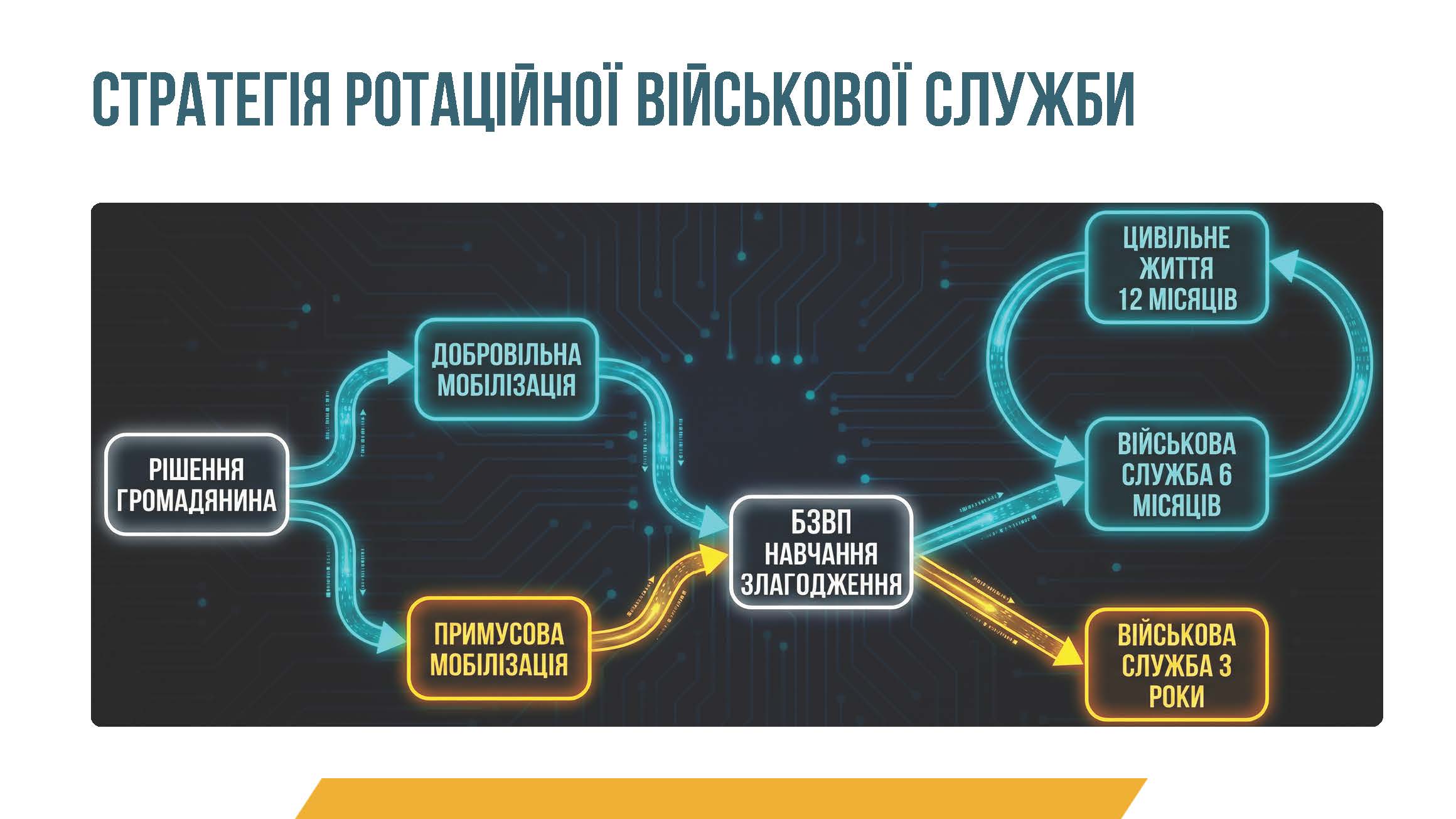
The rotational model of military service is a comprehensive analytical study implemented by the NGO “Foundation for the Promotion of Democracy” in September-December 2025.


The project is implemented by the NGO “Foundation for Promotion of Democracy” with the support of the Askold & Dir Foundation, administered by ISAR Ednannia, within the framework of the project “Strong Civil Society in Ukraine – Driving Reforms and Democracy” with funding from Norway and Sweden.

The contents of the project are the sole responsibility of the NGO “Democracy Assistance Foundation” and do not reflect the views of the governments of Norway, Sweden or ISAR Ednannia.

The project responds to one of the most acute problems of a long-term war: indefinite military service without the possibility of demobilization creates a vicious circle – the harder the service, the fewer people are willing to mobilize voluntarily, and the fewer new people join, the harder the service becomes for the current military. Forced mobilization only increases social tensions, and Russia actively exploits these fears to destabilize. Breaking this cycle requires a fundamentally new approach – a fair social contract in the form of a rotational model.

The initial concept of the rotational model was developed by the NGO “Democracy Assistance Foundation” together with mathematician Oleksandr Ivanov. As part of the project, the concept was adapted to the current realities of 2025 through three interrelated research areas.

The sociological study covered hard-to-reach categories of citizens: active military personnel, persons liable for military service who avoid mobilization (in Ukraine and abroad), Ukrainian refugees abroad, and military families. The quantitative survey was conducted through targeted advertising and dissemination in specialized communities; the qualitative survey was conducted using the snowball method with the maximum number of entry points to identify motives, fears, and expectations regarding service, rotations, and demobilization.

At the same time, a systematic OSINT and content analysis of the impact of Russian malicious narratives on attitudes towards mobilization was conducted using the Osavul tracking platform. The study identified key anti-mobilization narratives and channels of influence, based on which recommendations for counteraction were developed.

Based on the results of a sociological survey and narrative analysis, a mathematical model of the rotation system was updated using game theory to optimize rotation processes, predict the behavior of different groups, and evaluate effectiveness. The final model of the reform integrates international practices and principles of democratic governance and includes ready-made predictive manning scenarios, as well as a step-by-step plan for phased demobilization for different operational conditions, including a ceasefire scenario.

The results of the study are addressed to specific consumers: for the Ministry of Defense and the General Staff – a reasonable rotation model and forecast scenarios; for the Verkhovna Rada and the Government – policy options with resource and risk assessment; for the military and their families – predictable rules of rotation and rehabilitation; for persons liable for military service and employers – transparent rules of priority and clear windows of engagement.

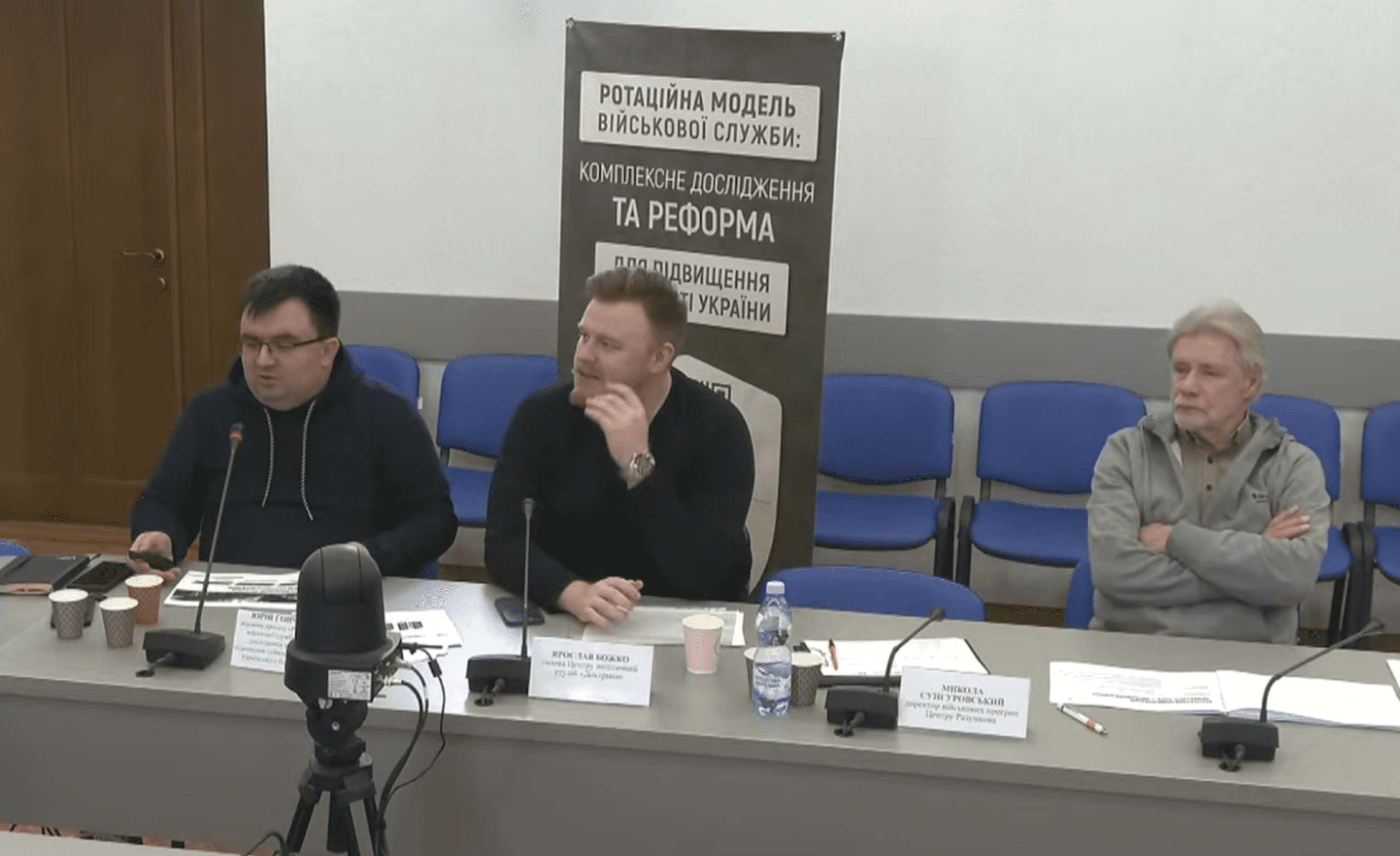
In December 2025, the results were presented at a public presentation in Kyiv as part of the Ukrainian Security Club. The advocacy strategy includes a presentation of the model to members of the Verkhovna Rada, submission of analytical notes to the Office of the President and the National Security and Defense Council, working meetings with representatives of the Ministry of Defense and the General Staff of the Armed Forces, and joint advocacy campaigns with veterans’ associations and initiatives of military families.

Start / End

The beginning:

2025

Conclusion:

2025

PROJECT MANAGER

Yuriy Goncharenko
Yuriy Goncharenko

Project manager at the NGO "Foundation for Promotion of Democracy"

PROJECT PAGES:

PARTNER:

LEARN MORE

Why this project is important

Indefinite service without the possibility of demobilization creates a vicious circle: the military is exhausted, and conscripts are avoiding mobilization in large numbers for fear of being out of the picture forever. Coercive methods only increase social tensions and the split between the military and civilians, and Russia actively uses these fears to destabilize.

A scientifically based model based on game theory that offers a fair social contract: predictable terms of service, guaranteed rotation and rest periods, and transparent rules of rotation. The model ensures a planned workload for the units and reduces personnel burnout.

The study covered hard-to-reach groups: active military personnel, persons liable for military service who avoid mobilization (in Ukraine and abroad), Ukrainian refugees and military families. This allowed us to identify the real motives, fears and expectations regarding service and rotations.

The model is addressed to specific consumers: The Ministry of Defense and the General Staff – for planning rotations, the Verkhovna Rada – for legislative changes, military personnel and their families – for predictability of service, and persons liable for military service and employers – for transparent rules of engagement.

The project is implemented by the NGO “Foundation for Promotion of Democracy” with the support of the Askold & Dir Foundation, administered by ISAR Ednannia, within the framework of the project “Strong Civil Society in Ukraine – Driving Reforms and Democracy” with funding from Norway and Sweden.
The contents of the project are the sole responsibility of the NGO “Democracy Assistance Foundation” and do not reflect the views of the governments of Norway, Sweden or ISAR Ednannia.

OTHER PROJECTS