The June 12 announcement of reforms to military pay and terms of service took place against a very challenging backdrop—particularly after the Verkhovna Rada adopted budget amendments that included an increase in the base salary for police officers, while the issue of military pay was buried within the overall figure of 1.46 trillion hryvnias. In …

The June 12 announcement of reforms to military pay and terms of service took place against a very challenging backdrop—particularly after the Verkhovna Rada adopted budget amendments that included an increase in the base salary for police officers, while the issue of military pay was buried within the overall figure of 1.46 trillion hryvnias. In and of itself, the decision to modernize the pay system for police officers and emergency responders may be the right one. But at a time when the military was awaiting answers regarding terms of service, fair pay, and a clear mechanism for discharging those who have served the longest, this sequence of communications served as a source of irritation.
Further unrest among the military arose over the 40 billion hryvnias allocated to a special budget fund, while not a word was said about the military. What matters here is not so much how the government explained it, but how it was perceived by the military and the public.
At the same time, the reform had been announced as early as June 1, and no public explanation for the delay was given. Consequently, this communication vacuum was filled with despair, fatigue, and a sense of injustice—and, to be honest, with the political expediency of certain opinion leaders and Russia’s destructive influence.
Yurii Honcharenko, Head of the InfoLight.UA Research and Analysis Group
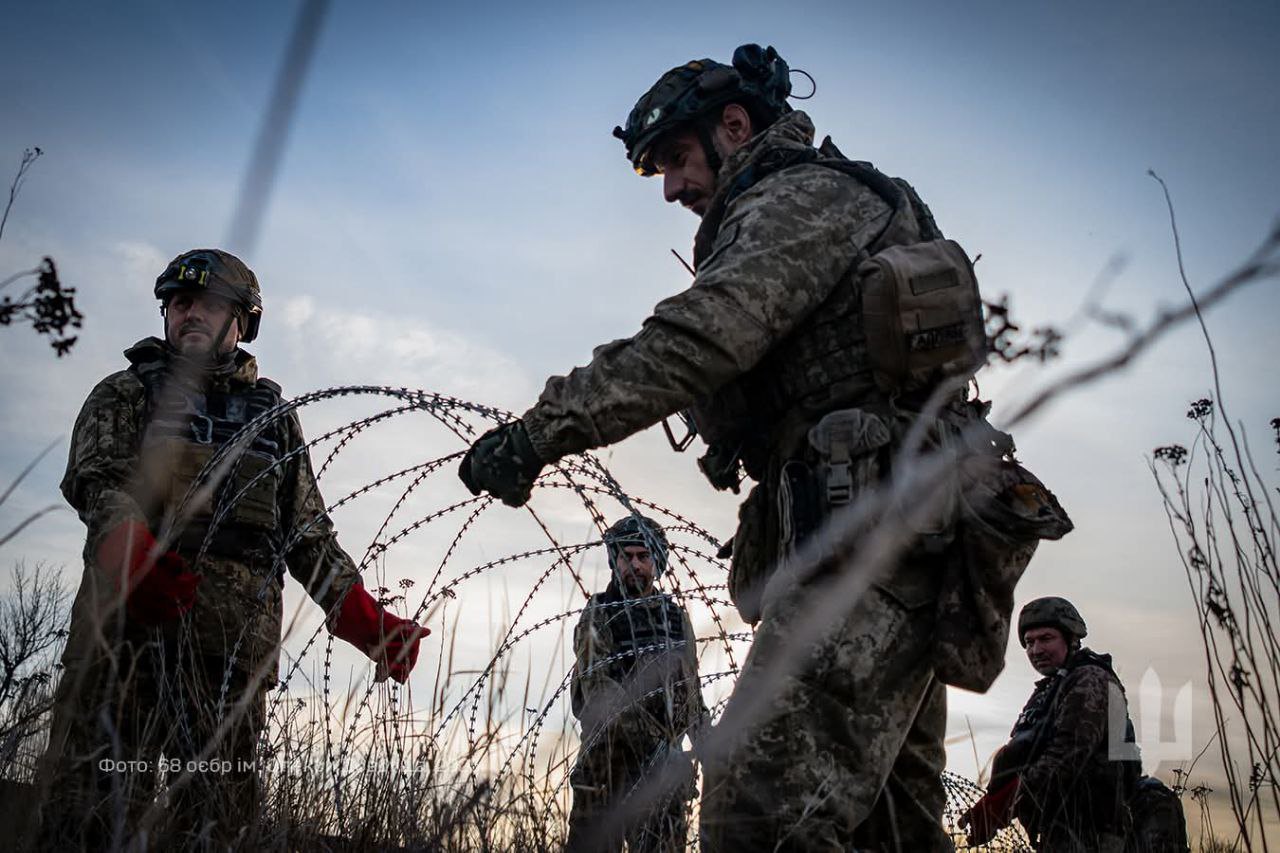
PHOTO: GENERAL STAFF OF THE ARMED FORCES OF UKRAINE
Where the state remains silent, an enemy always emerges.
In the end, the reform was announced, but the promotional video, a few general posts, and a visually appealing yet difficult-to-understand website did little to clarify the situation. The government resolution itself (No. 768 of June 12, 2026) was published only two days later and took effect on June 15, and all the while, social media and the press were passionately discussing the most complex and long-awaited reform of the security and defense sector.
Since the team at the InfoLight.UA Research and Analysis Group was there at the very beginning of this reform —we began communicating its principles as early as November–December 2024— and provided a detailed explanation at a press conference on February 6, 2025, — I will take the liberty of explaining the logic behind the Ministry of Defense’s actions, the details of the reform (including those not yet formalized in resolutions), the expected next steps, and the data and figures on which it was based.
Please read the entire text, because the explanations—including how and on what basis the reform was planned, and why its parameters in the summer of 2026 are different from what they might have been in the spring of 2025—are important. Without an explanation of the logic behind it, this reform looks like nothing more than a set of contracts and payments. In reality, however, it is the first, cautious, and far from perfect step toward a new social contract on defense.
I would also like to acknowledge our entire team at the “Foundation for Democracy Assistance” NGO, as well as our partners at the Hanns Seidel Foundation in Ukraine and ISAR “Yednannia,” who believed that change in this area is possible.
The Problem of Mobilization and the Search for Solutions
Our team began systematically monitoring Russia’s destructive influence on the mobilization process back in 2022. At the time, many people thought this was a minor information-related issue. In reality, it was one of the state’s key vulnerabilities.
Russia was working not only against the TCC, not only against military registration, and not only against specific decisions by the authorities. It was working against the very idea of a fair defense obligation. Its goal was to make the military feel abandoned, civilians feel frightened, and the state appear incapable of explaining the rules.
Until the fall of 2023, it was considered normal to ignore these problems, and in December 2023—to make rather populist statements that were not backed up by concrete actions. It was then that demobilization was first discussed at the state level, work began on reforming mobilization legislation, and the topic attracted the attention of the media and the public. However, the key point of this article is the announcement of demobilization itself.
I won’t go into detail about what happened next or the flaws in the legislation that took effect on May 18, 2024—our team has covered all of that in depth in this series of articles. This introduction was necessary to explain the logic behind the development of the issue, as the term “fixed terms of service” began to gain more and more attention.
Rotational model of military service
This model was proposed and described in detail by Alexander Ivanov, who holds a PhD in applied mathematics—for example, in this article. The InfoLight.UA research and analysis group took on the other part of the work—verifying the mathematical conclusions of game theory-based modeling through surveys of closed social groups. We conducted several rounds of surveys: we spoke with those stereotypically referred to as “draft dodgers,” with refugees, with military personnel, and with a broad cross-section of Ukrainians. These included both in-person interviews and detailed questionnaires with over 50 questions, similar in content and quality to in-depth interviews.
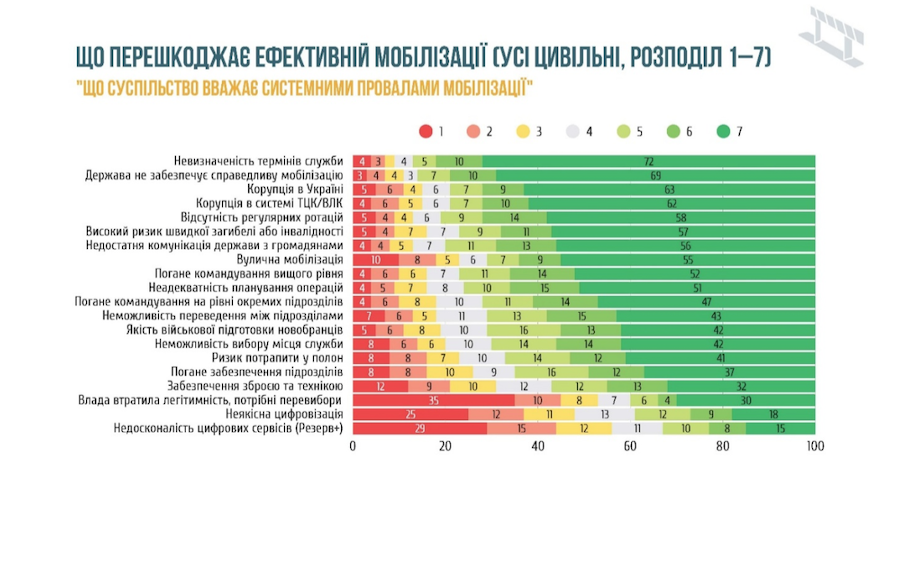
We never referred to this data as classic representative sociology. It was an exploratory study of hard-to-reach groups and motivations. But the trends it revealed were very clear.
No matter how we framed the question, about one-third of Ukrainians stated that they would join the Armed Forces of Ukraine if a rotational model of military service were implemented. It is worth noting that, over time, the proportion of those in this group who were willing to take the government’s word for it declined rapidly, and the majority demanded either clear legislative provisions or that the government demonstrate in practice that it could be trusted.
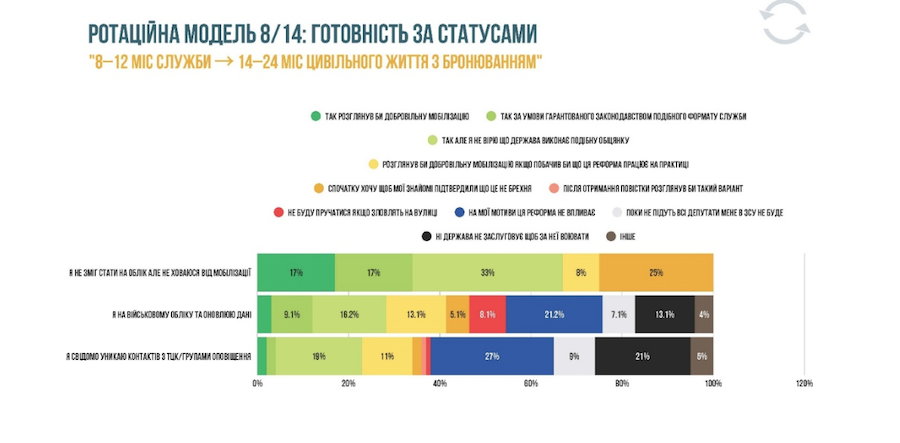
This is important for understanding the negative reaction to the proposed reform, as it fully aligns with our surveys.
It is equally important to understand that, starting in November 2024, the rotation parameters we examined were constantly changing—specifically, the length of service and the deferral period. The proportion of deferrals decreased, which was also to be expected.
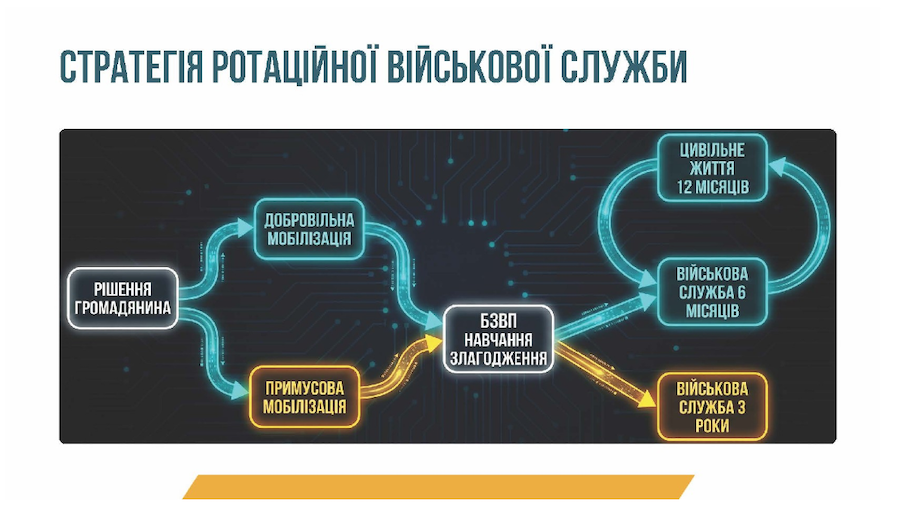
But the logic behind the reform has not changed: citizens who are not yet in the military are offered a choice—either to voluntarily join the military under clear terms with a defined period of service, or to be forcibly mobilized for the entire duration of the war. And this process must be carried out with increased and more systematic enforcement, so that it is impossible to avoid mobilization.
Important: For those already in the military, a different system was supposed to be in place, one that provides for immediate demobilization as soon as new recruits join the ranks.
What has changed?
It is clear that different parameters for military rotations have been announced. And the first communication error that needs to be acknowledged is the impression that the announced parameters were designed for current military personnel. This is not the case. The proposed and approved changes concern the recruitment of new personnel—the first stage in implementing the rotational model of military service. That is precisely what should have been emphasized.
It is also worth explaining the figures themselves. According to Resolution No. 768, an incentive contract can be signed for a term of 6 to 24 months, depending on the category: 14 months for civilians, 10 months for active-duty military personnel, and 6+ months for discharged personnel with combat experience. Combat and basic contracts are for 24 months. The deferment period following the contract starts at 6 months and may be extended depending on the number of days in combat and prior service.
Why aren’t these the conditions that some members of society would like to see in 2024 or early 2025?
The simple answer: because it is now the summer of 2026, and the mobilization situation is much more complicated than it used to be.
A more complex answer: The General Staff, as an institution responsible not for polished communication but for the stability of the front lines, cannot base its model on an optimistic scenario. It must proceed from a conservative forecast: What if the new contracts do not provide the expected reinforcements? What if the recruitment rate is lower than expected? What if Russia simultaneously steps up its own mobilization efforts?
That is precisely why the parameters seem stricter than many would like. They were not chosen to please everyone, but to ensure that the reform would not have to be scrapped in two months with the excuse that “it didn’t work.”
And here, as strange as it may sound, there is a silver lining: the government is finally planning not only for the best-case scenario, but also for the worst-case scenario.
Clear terms of service
Demobilization for active-duty military personnel will begin as early as 2026. This is a key change, the details and regulatory framework of which are still being worked out. And this is the second communication mistake—it was neither emphasized nor explained.
The presentation of the reform was mechanical and technical: here’s a nice website, here are the new contracts laid out, here’s the scheme for “calculating” deferments. No details were provided. And the main reason for this reform—that the country’s defense must become the responsibility of society as a whole—was not mentioned. The result of all stages of the reform will be that every person subject to military service will, in one way or another, end up in the Security and Defense Sector.
And here a clarification is needed, without which this argument can easily be misrepresented. The security and defense sector is a broad concept: it encompasses not only assault units and the front lines, but also the rear, logistical support, territorial defense, cybersecurity, critical infrastructure, and dozens of other functions. This is not about “sending everyone to the trenches,” but rather about a model in which everyone is involved in defense—based on the principle of “serve or support.” That is precisely why these changes have been called a transformation.
And while I hope the Ministry of Defense will forgive me, I must explain the full logic behind these changes: creating conditions under which it will be impossible to avoid military service, strengthening and at the same time streamlining the enforcement process, and closing loopholes that allow for evasion. However—and this is fundamental—strengthening coercion is legitimate only when it goes hand in hand with fairness, clear deadlines, and the state’s fulfillment of its own promises. Otherwise, we will return to where we started—to the mistrust documented by our surveys.
In other words, the next stages of the reform involve changes to mobilization, deferrals (with a view to reducing them), record-keeping, audits of the effective use of personnel in the Armed Forces of Ukraine, and other decisions. The goal of all these changes is to ensure a stable troop strength, rotational participation in the country’s defense, and predictability for employers.
And most importantly—justice, where no one in society is “chosen”—as if the country’s defense did not exist for them—and no one is forced to serve on behalf of the rest of Ukrainians. This is the key philosophy behind the reform.
Clear terms of service, the duration of deferments, and demobilization are directly linked to how successfully new recruits are enlisted into the military. After all, the alternative to these changes is no changes at all, and a significant portion of the government and members of parliament are already categorically opposed to them. That is precisely why everything was adopted by a government resolution: it was impossible to push these changes through the Verkhovna Rada within a reasonable timeframe, given the presence there of a significant number of populists opposed to mobilization, whose names are well known to everyone.
Here, we should also be honest about the flip side: adopting such a far-reaching decision through a subordinate legislative act, bypassing parliament, comes at a cost—both to the quality of public dialogue and to the very logic of democratic procedures. This is a necessary compromise, not the norm, and that is precisely why, according to my information, the relevant bills are still being drafted.
Complex Issues
I will now take the liberty of explaining—or responding to—the most pressing questions and concerns regarding the reform on behalf of the Ministry of Defense.
When will those who have been in the military for a long time be demobilized?
Mykhailo Fedorov stated explicitly that this demobilization will take place pursuant to a separate decision—a presidential decree—using mechanisms different from those for contract deferrals. A general waiting list for demobilization will be formed, with placement on the list determined by length of service: those who enlisted between 2014 and 2022 will be first in line. The number of soldiers demobilized each month will depend on the situation on the battlefield and the success of changes to the mobilization process. This is another component of the transformation of the Security and Defense Sector, and it will begin in the fall.
What will happen to those who don’t sign the new contract?
- As far as financial support is concerned, everyone will receive the new combat pay, regardless of whether they have a contract: both those who have been mobilized and those serving under an old contract. These provisions have been in effect since June 1, 2026.
- For service members who enlisted between 2014 and 2022, declining a new contract will not affect their demobilization.
- As for the length of service—they will serve until it is their turn to be demobilized, which means, most likely, longer than those who sign a fixed-term contract. This does not apply to those already in the military—some will be eligible for demobilization before their contracts expire.
Where is the principle of “the longer you’ve served, the more time off you get” legally enshrined? How will it work?
This is set forth in the Implementation Procedure, paragraph 22, and reflected in the logic of deferrals: the base deferral is 6 months, and it increases thereafter depending on the number of months of service. However, it must be acknowledged that this mechanism requires a clearer explanation, as well as the next stages of the reform, which will address those who are next in line for demobilization.
Why not increase the base pay for everyone, instead of providing mainly additional payments?
This follows from the budget’s capacity. The cost of a universal pay raise is easy to calculate: multiply the estimated number of troops (let’s say one million) by 12 months and by the amount of the raise.
10,000 × 12 × 1,000,000 = 120 billion hryvnias (nearly 80% of the amount approved).
Accordingly, the Ministry of Defense proceeded based on its available financial resources and opted for differentiated payments—the highest for those directly carrying out combat missions (up to 20,000 UAH per day of assault operations deep within their own forces’ defensive lines and up to 40,000 UAH deep within the enemy’s defensive lines, with a maximum monthly allowance of 460,000 UAH).
However, the basic pay was raised from 20,000 to 30,000 UAH.
And to avoid any confusion, let me emphasize: the underlying logic of the reform is not a uniform increase in the “base” salary for everyone, but rather an increase in compensation for actual risk and results. It is precisely this point that should have been explained from the outset.
What is the process for returning after a deferment? (Do I have to sign a new 2-year contract, or can I choose my unit myself, etc.)
These issues will be further clarified, and there is at least a year to do so. The main thing right now is to get the mechanism up and running; the details regarding return, unit selection, and the terms of the new contract will be finalized in subsequent stages.
Are high benefits maintained during medical treatment, vacation, education, or after an injury?
Periods of leave, training, and medical treatment are included in the total duration of the contract. Following a combat injury, the servicemember continues to receive their regular pay, and an additional payment of 100,000 UAH is paid for the duration of inpatient treatment. During medical leave, pay is retained only if the soldier has suffered a severe injury, as determined by the Medical Examination Commission. This must be explained separately and very clearly to service members, because it is precisely these details that build or destroy trust.
Can military personnel in officer positions sign new contracts?
Officers are a separate and complex category. It has already been publicly stated that the first wave of gradual discharges will not affect the officer corps, and new contracts for officers under the current reform must be for at least two years. This is an unpopular but understandable logic: the officer corps is a critical human resource, and the state cannot afford to lose its commanders and specialists all at once.
But it all depends on how the reform proceeds, and the Ministry of Defense does not deny that the demobilization of officers could begin sooner.
Defensive Democracy
Our team consistently upholds the principle of “serve or help.” A long war against Russia cannot be the responsibility of only the Armed Forces, only volunteers, only those mobilized in 2022, or only those who were unlucky enough to be in the first wave.
But neither can national defense be used as an excuse for tyranny, isolation, and dictatorship.
That is precisely why we speak of a “defense-oriented democracy.” It is a balance between coercion and incentives, between freedoms and responsibilities, between governability and transparency, and between the needs of the front lines and human rights.
Defensive democracy is not weakness. It is a strong state that honestly explains the rules to its citizens and abides by them itself.
Defensive democracy does not mean “everyone does whatever they want.” It is a system in which evading one’s defense obligations becomes impossible, but coercion is lawful, digitally controlled, non-discriminatory, and accountable.
Defensive democracy is not about political support for a specific minister, government, or party. It is about supporting the right direction of change, with the right and the duty to criticize mistakes.
In a situation where the mobilization issue was initially ignored, then swept under the rug, then misinterpreted, and is now being exploited by many as a tool for political publicity, we cannot expect a perfect reform right from the start.
But we can and must demand that things move in the right direction.
This first stage is not the end of the reform. It is only the beginning. It has many weaknesses in terms of communication, legal details, and trust. But for the first time, it opens the door to a model where service is time-bound, risk has a price, long service is prioritized, and the defense of the country becomes the responsibility of society as a whole.
Therefore, we will support the movement for change while also keeping it in check.
To help where the government is finally moving in the right direction.
To criticize her when she remains silent, is confused, or doesn’t say everything.
Because the goal isn’t for anyone to win a communications battle on Facebook.
The goal is for Ukraine to hold out.