The current state of Ukrainian-Polish interethnic relations: Relations are complex and are steadily deteriorating due to the Polish side's resort to unilateral revision of controversial moments in history, denial of Ukrainian heroism and national memory, which provokes resistance from Ukrainians. What is the priority of Ukrainian-Polish relations for Ukraine? Finding the grounds, mechanism, and algorithms …
- The current state of Ukrainian-Polish interethnic relations:
Relations are complex and are steadily deteriorating due to the Polish side’s resort to unilateral revision of controversial moments in history, denial of Ukrainian heroism and national memory, which provokes resistance from Ukrainians.
- What is the priority of Ukrainian-Polish relations for Ukraine?
Finding the grounds, mechanism, and algorithms for establishing relations (reconciliation) is impossible without addressing the extremely controversial area of national memory. The formula “we forgive and ask for forgiveness” did not work. We need a different approach.
- Mutual protection of “related minorities” is such a construct because:
- The European tradition of protecting the rights of minority ethnic groups is an effective one.
- The leftist (“cultural Marxism”) and liberal doctrines, hostile to conservatives (and the current Polish, but also Ukrainian government), envisage the blurring and mixing of the titular nation, national minorities and indigenous peoples into a denationalized society (distortion of the idea of a “political nation”).
- Therefore, the protection of the rights of all ethnic groups in a state is beneficial to both its titular nation (protection against “dilution”) and indigenous peoples/national minorities (protection against assimilation) and is evidence of respect for democracy and human rights; it is in line with true Western and European values.
- Protection of the rights of Poles in Ukraine is in demand by the Polish state:
4.07.2017 Polish Foreign Minister W. Waszczykowski stated that Ukraine needs to properly protect the rights of the Polish minority, despite the fact that ethnic Poles made up only 363 thousand in 1959 and only 144 thousand in 2001, living compactly in only one district of Lviv, in some districts of Khmelnytsky and Zhytomyr regions, and are actively assimilating.
- Ukraine has a long tradition of protecting the rights of national minorities:
- The Law of the Ukrainian Central Rada “On National and Personal Autonomy” of 9(22).01.1918 – the right to extraterritorial “national unions” for the three largest “nations” after Ukrainians UPR: Russians, Jews, and Poles.
- Section VII. “National Unions” of the UPR Constitution (Statute on the State System, Rights and Freedoms of the UPR) of April 29, 1918.
- The practice of forming national districts in the Ukrainian SSR in the second half of the 1920s – their existence in the first half of the 1930s.
- The Declaration of State Sovereignty of Ukraine of 16.07.1990 No. 55-XII – “The Ukrainian SSR independently determines the administrative-territorial structure of the Republic and the procedure for the formation of national-administrative units” (Section 5. Territorial supremacy).
- The Declaration of the Rights of Nationalities of Ukraine of 01.11.1991 No. 1771-XII – “The Ukrainian state … ensures the existence of national administrative units” (Article 2).
- How the proposed model of mutual reconciliation should work:
- The final refusal of the Ukrainian, but above all the Polish side to politicize historical memory and abuse of names (Bandera-Shukhevych – Pilsudski-Dmowski) or events (the Volyn Tragedy – Operation Vistula) in political discourse. However, at the same time, each side will remember and honor its heroes, tragedies and significant dates. Focusing on the protection of their minorities.
- Establishment of two or three territorial communities in Ukraine with a majority of ethnic Polish population in areas that do not border Poland.
- Official recognition of the Ukrainian language as a regional language, along with the state Polish and regional Belarusian, in those 3-4 Polesie gminas where, although formally dominated by Belarusians, Poles (southern Podlasie) actually live, and which do not border Ukraine.
- Ukrainian would become the regional language in one or more gminas of the Lemkivshchyna, where more than 10% of Ukrainians (Lemkos) live and which do not border Ukraine.
- Officially recognizing Ukrainians and Lemkos (Rusyns) as one group or including both groups (considering them together) when calculating the percentage of minorities in gminas to determine their right to a regional language.
- The proposed system of mutual protection of the rights of “related minorities” is octroi (not a RIGHT to self-determination, although it is a form of actual internal self-determination of a minority authorized by the state), contractual and consensual (not established by the will of the communities themselves) and, in case of violation of the agreements, ceases to exist until the territories of the communities can be changed.
APPENDICES
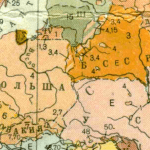
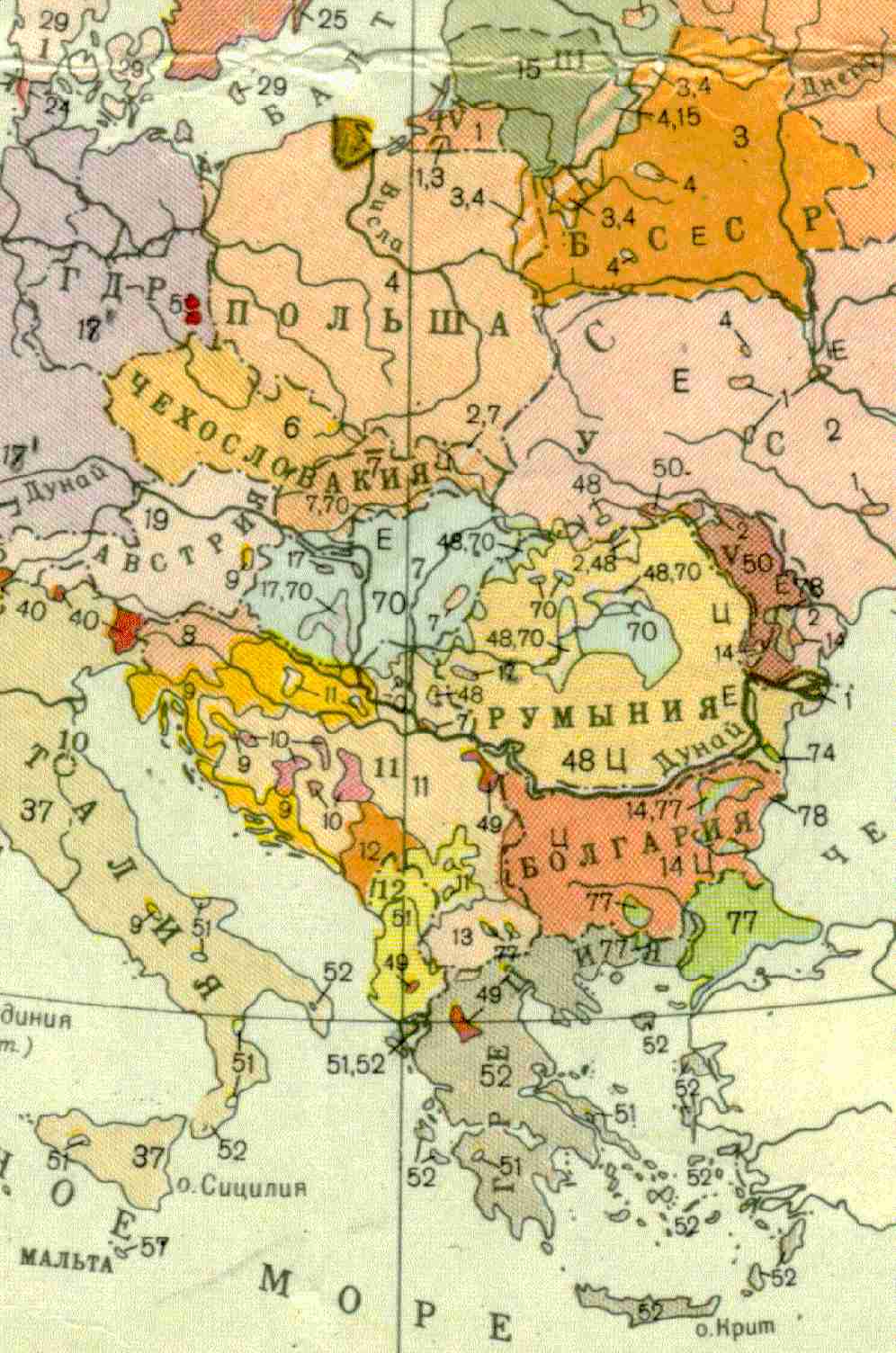
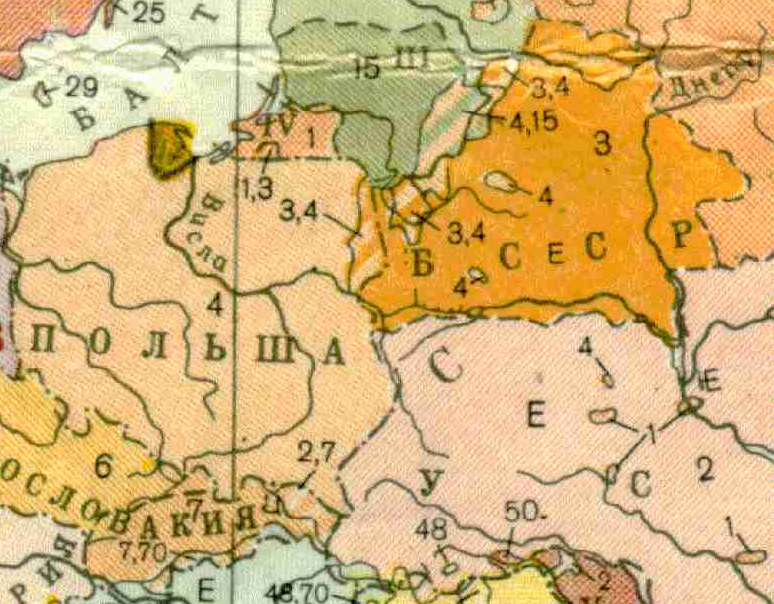
Appendix 1. Mutual settlement of Poles in Ukraine and Ukrainians in Poland as of the postwar years 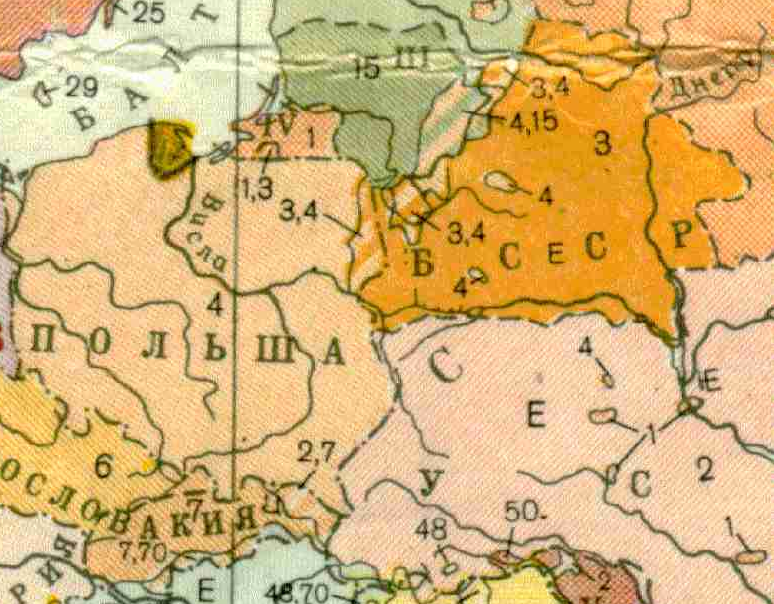
http://luzicane.narod.ru/AT153.jpg
As a result of the forced exchanges of the Ukrainian-Polish population carried out by the communist authorities of the USSR and Poland, the latter got rid of the “Eastern Kresy” (who thereby finally established and realized their political self-determination by joining Ukraine or Belarus), but it also destroyed the compact autochthonous Ukrainian irredenta on the eastern border by evicting 140,000 Ukrainians from Zakerzonia and dispersing them (the number of Ukrainian immigrants in the new communities could not exceed 10%) in the newly annexed western lands from Germany.
One can agree with the statements that “there was a definite exit of Poland from internal Ukrainian history, as well as of Ukraine from Polish history”[1] , and that the scattered Ukrainians in Poland gradually lost signs of their ethno-cultural separateness and eventually disappeared from Polish history and agenda[2] – but not entirely!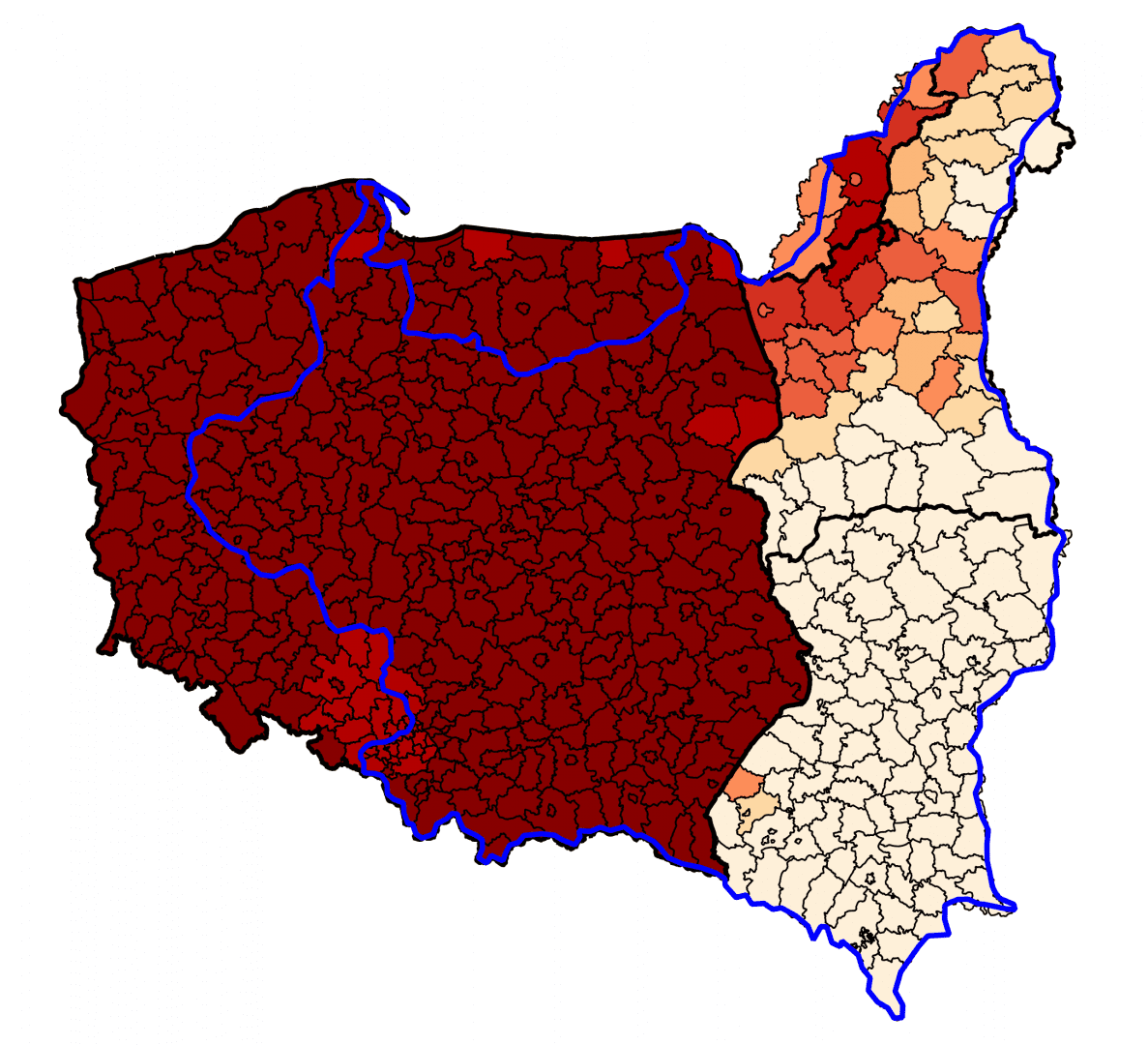
www.andrzejgrych.pl/wp-content/uploads/2015/01/m16708601MAPA1-V2.png
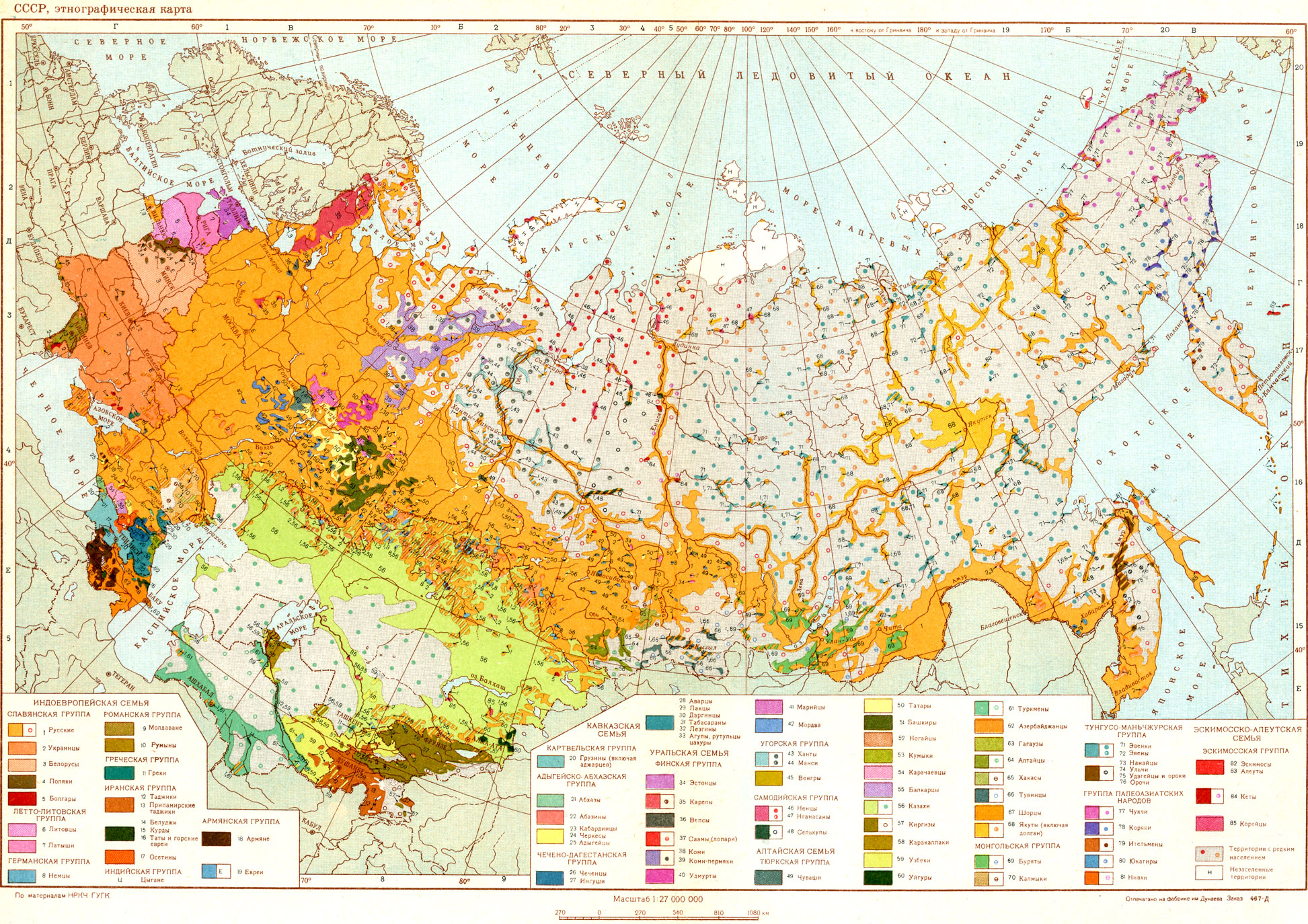
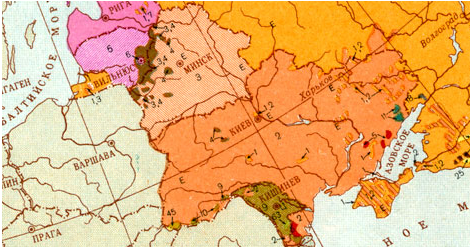 Despite the fact that the overwhelming majority of the foreign Polonia (Polish diaspora) has survived today only in Belarus, where it is essentially a permanent resident, the topic of proper national-territorial protection of the rights of Ukrainians in Poland and Poles in Ukraine has the potential for reconciliation http://luzicane.narod.ru/AT153.jpg
http://geoman.ru/geography/item/f00/s03/e0003500/pic/000005.jpg
[1] Rusnachenko A. Ukrainian-Polish relations in the XX century: the view of the Ukrainian author // In search of the truth: collection of materials of the international scientific conference “Ukrainian-Polish conflict during the Second World War: genesis, nature, course and consequences”, Lutsk, May 20-23, 2003 / compiled by V. K. Baran. M. Kucherepa, M. Moklytsia, V. Hrebenyuk – Lutsk: Lesya Ukrainka Volyn State University, 2003. 536 p. – С. 21-36. – С. 32.
[2] http://litopys.org.ua/ukrxx/r08.htm
Appendix 2. Legal grounds for the formation of communities with
by the Polish majority in Ukraine
This is the basis on the Ukrainian side. The Law of Ukraine “On Voluntary Amalgamation of Territorial Communities” of 05.02.2015 No. 157-VIII – Article 4. Basic conditions for voluntary amalgamation of territorial communities
- Voluntary amalgamation of territorial communities of villages, towns, and cities is subject to the following conditions:
2) the territory of the united territorial community should be indissoluble, the boundaries of the united territorial community are determined by the external jurisdiction of the councils of the united territorial communities;
4) when making decisions on the voluntary amalgamation of territorial communities, historical, natural, ethnic, cultural and other factors affecting the socio-economic development of ATCs are taken into account
It is noteworthy that the methodology developed pursuant to the relevant law no longer contained any normative hints of internal self-determination or protection of minorities: it did not refer to ethnicity, instead making the formation of a community dependent on “historical, geographical, socio-economic, cultural peculiarities of the development of the relevant administrative-territorial units.” Other significant factors in the formation of new communities were (paragraphs 2.3 of the Methodology):
- Voluntariness of the amalgamation (the peculiarities of the ethnic and linguistic composition of the settlements could have a passing influence on this factor);
- The ability to ensure accessibility and proper level of social and administrative services in the areas of education, culture, healthcare, social protection, housing and communal services;
- Financial, human, and infrastructure capacity, taking into account human resources, financial support, and infrastructure development of the relevant administrative-territorial unit[3];
- Some demographic factors (such as labor migration)[4].
Annex 1. Possible territorial location of one Polish community in the Mostysk district (Lviv region)
Despite the Bolshevik exchange of population in Ukraine, there remained compact areas of the Polish national minority, which, despite the rapid return of Ukrainians to their roots in the postwar years (as a significant part of the Poles in Ukraine were once assimilated Ukrainians)[5], have survived to this day. As of 2001, 7.6% of Poles lived in the Mostysk district of Lviv oblast, 7.8% in 1989[6], and 15% in 1959. That is, after an intensive “return to their roots” of Latinists and people of mixed Ukrainian-Polish descent, purely ethnic Poles in the Mosty region have ceased to lose their ethnically defining Polish characteristics.
Since 2015, Ukraine has been implementing a decentralization reform that provides for the formation of self-sufficient territorial communities, including those based on ethnicity. The formation of Mostyska, Dovbyshivska, and, say, Polonska Polish communities in Ukraine would be the key to a new attempt at understanding, provided that the Polish side abandons post-imperial chauvinism, further accusations of historical crimes against Ukrainians, and similar national and territorial protection of Ukrainians in Poland. Such a plan is beneficial to both sides, but in terms of minorities and communities, it is more beneficial to the Polish side, as it preserves and partially revives Polonia in Ukraine. This initiative does not in any way threaten the territorial integrity of Ukraine.
[3] The Cornerstone Book on Decentralization is available here.
[4] Resolution of the Cabinet of Ministers of Ukraine “On Approval of the Methodology for the Formation of Capable Territorial Communities” of 08.04.2015 No. 214: http://zakon4.rada.gov.ua/laws/show/214-2015-%D0%BF/paran10#n10.
[5] Zawada A. Breslav // New Poland. Special Ukrainian issue. – 2005. – С. 76-85. – С. 79.
[6] On the number and composition of the population of Lviv region according to the results of the All-Ukrainian population census of 2001 All-Ukrainian population census 2001 – State Statistics Committee of Ukraine // http://2001.ukrcensus.gov.ua/results/general/nationality/lviv/
Annex 2. Possible territorial location of Polish communities in Khmelnytskyi and Zhytomyr regions
The situation is somewhat different with the Polish population of Zhytomyr and Podillia, which is being intensively assimilated today, and as of 2017, it is clearly less than the census figures. Unlike in Western Ukraine, there was no violent Ukrainian-Polish confrontation here, but the Soviet Holodomor, collectivization, and deportations of the Polish population by the Bolsheviks did take place.
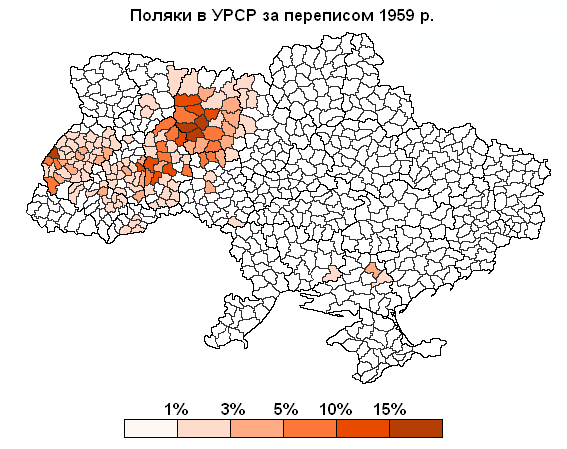
In the Khmelnytsky region, the number of ethnic Poles in the Horodok district is 7.2% (in 1989 – 9%, in 1959 – 13.8%) and in the Polonsky district 6.6% (in 1989 – 8.3%[7], in 1959 – 12%).
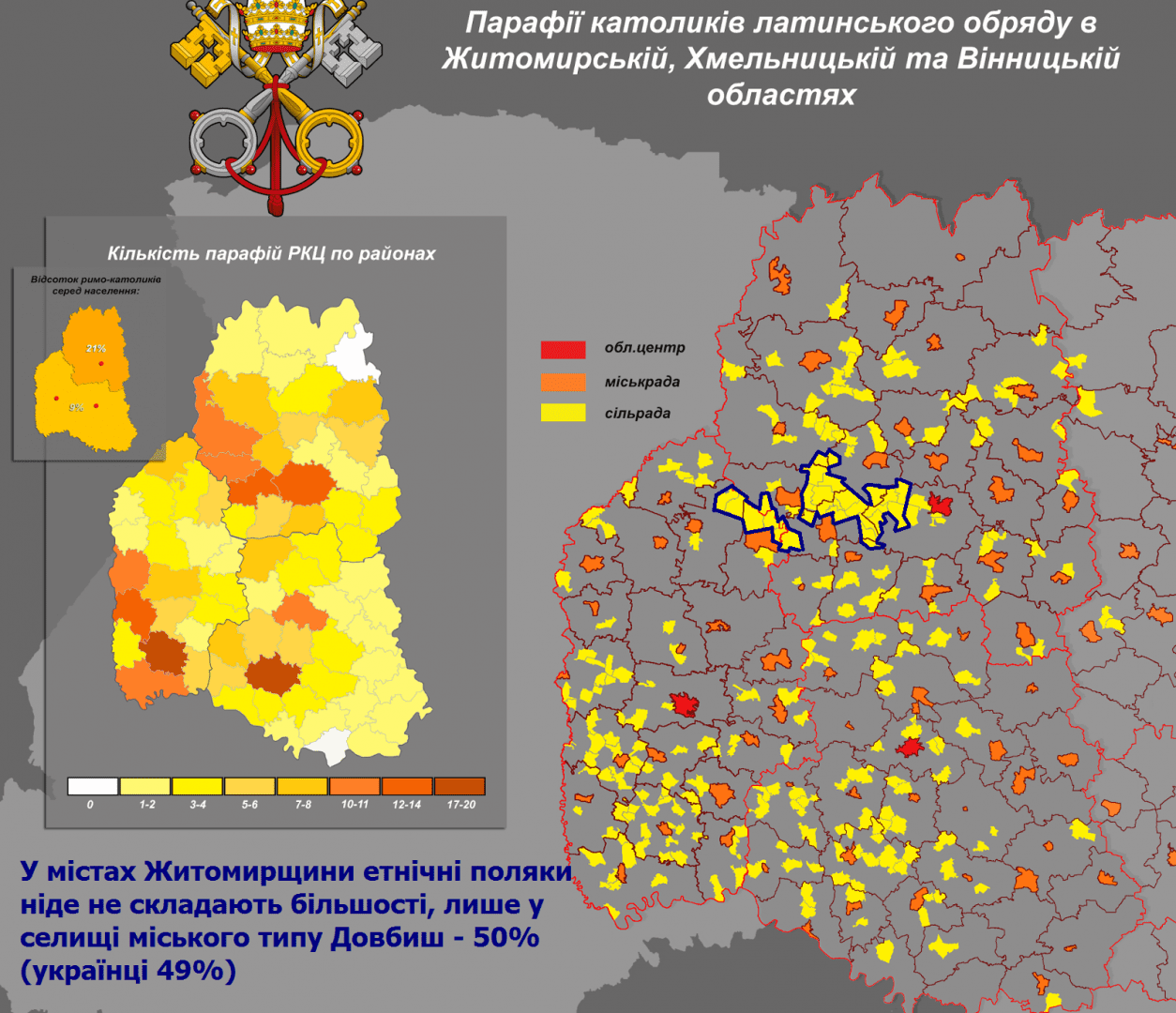
In the Zhytomyr region in the districts: Baranivsky – 10.7% (in 1959 – 17.6%), Romanivsky – 10.6% (16.4%), Pulynsky – 8.9% (15.8%)[8]. In 2009-2012, in the former center of the Markhlevske Polish National District, the urban-type settlement of Dovbush, ethnic Poles accounted for 50.6% (Ukrainians – 49.2%)[9]. Polish estimates of 75% of Poles in the city and surrounding villages are overstated and based on pre-war data, while after the liquidation of the district in 1935, the Bolsheviks deported a significant part of the Polish population to Kazakhstan, from where Poles moved to Poland after the war, mostly to “odziskan lands.”
[7] On the number and composition of the population of Khmelnytsky region according to the results of the All-Ukrainian population census of 2001 All-Ukrainian population census 2001 – State Statistics Committee of Ukraine // http://2001.ukrcensus.gov.ua/results/general/nationality/khmelnytskyi;
[8] Kabuzan V. M. Ukrainians in the world: dynamics of population and settlement. The 20s of the XVIII century – 1989 Formation of the ethnic and political borders of the Ukrainian ethnos. / Institute of Russian History of the Russian Academy of Sciences. – Moscow: Nauka, 2006. – 658 p. – С. 603-604, 606-607, 619; Distribution of the population by nationality and native language, Zhytomyr region // Nationality and language features (2001(05.12)) // National composition of the population, language features, citizenship // http://database.ukrcensus.gov.ua/MULT/Database/Census/databasetree_uk.asp
[9] HISTORICAL REFERENCE OF DOVBYSH VILLAGE OF BARANIVSKYI DISTRICT OF ZHYTOMYR REGION // Dovbysh Village Council. Official website // http://dovbysh-rada.gov.ua/index.php/pro-selyshche/34-istorychna-dovidka/1-news001
Markhlevsky Polish national district in the Zhytomyr region in 1931-35.
(Poles – 70% or 30 thousand, 1-3 thousand people died of starvation, 10 thousand were evicted in 1935).
Unlike the Khmelnytsky and Vinnytsia regions, it was the Zhytomyr region that had an administrative-territorial Polish entity, the Markhlevshchyna. In 1930, the population of the district was 52 thousand people, of whom 36.4 thousand were Poles. 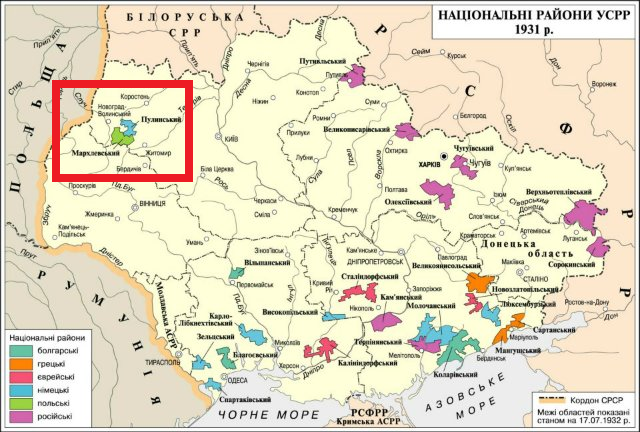
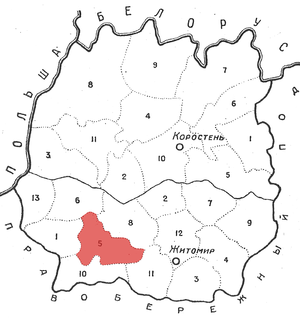 In 1932-33, 1-3 thousand people died in the Holodomor, up to 2 thousand Poles.
In 1935-39, 10 thousand people were deported, mostly Poles. The entire population suffered significant losses during World War II.
In the context of the proposed Polish-Ukrainian reconciliation, Ukraine can currently protect the Polish minority in Zhytomyr Oblast from further assimilation by forming an ATC on part of the former Markhlevshchyna territory, uniting villages with a Polish ethnic majority into such a community. Unfortunately, the 2001 All-Ukrainian Census does not have data on the national composition at the village level. Estimates of the current settlement of Poles in the Zhytomyr region can be made based on the 1959 census
Instead, there are data on Roman Catholic parishes in the Zhytomyr and Podillia regions, which provide at least a rough outline of the current areas of Polish settlement at the level of villages and towns (since ethnic Poles are in the minority in cities).
Thus, on the border of Khmelnytskyi and Zhytomyr regions, it is quite possible to form two ATCs (communities) with a compact ethnic Polish population, where ethnic Poles will make up the majority of residents.
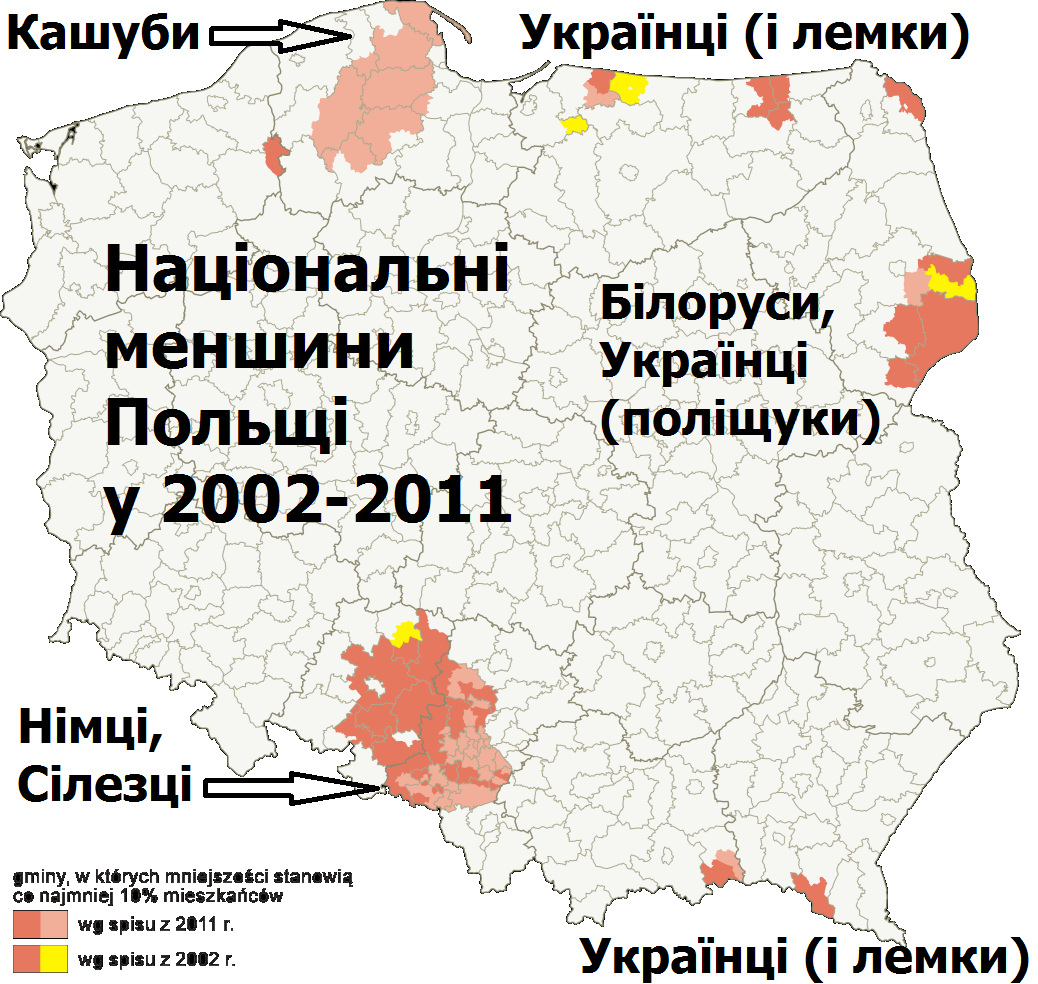
Appendix 4. Distribution of the ethnic Ukrainian population (Ukrainians, Lemko-Rusyns, Poleschuks-Belarusians) in gminas of modern Poland
Communities in which national minorities accounted for more than 10% according to the of the 2002 and 2011 Polish censuses.
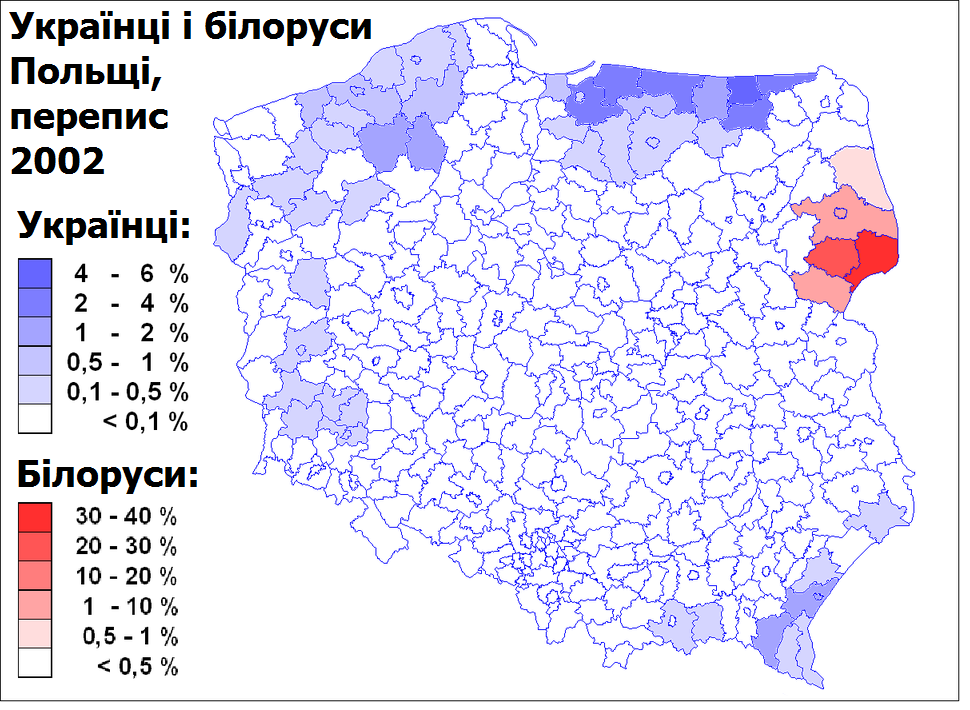
The number of “Belarusian” (Ukrainian-Polish-Belarusian) population in gminas of the Podlaskie Voivodeship according to the 2002 Polish census.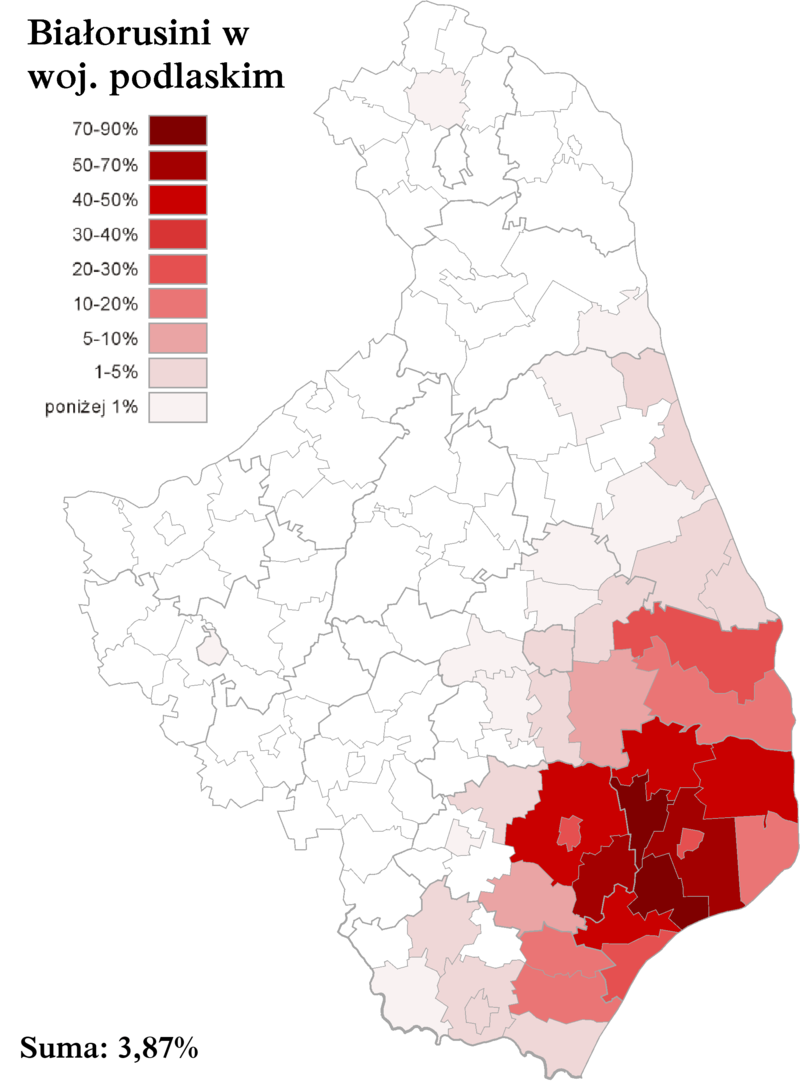
| % of “Belarusians” in 16 communes of the Podlaskie Voivodeship | % |
| Czyży Commune |
81,81 |
|
81,33 |
|
|
68,93 |
|
|
64,91 |
|
|
49,23 |
|
|
46,68 |
|
|
47,27 |
|
|
41,83 |
|
|
28,71 |
|
|
26,41 |
|
|
23,07 |
|
|
20,66 |
|
|
16,36 |
|
|
14,17 |
|
|
13,09 |
|
|
11,54 |
Appendix 5. Why this model of reconciliation and mutual territorial protection of related minorities is also applicable to Podlasie
 Ukraine cannot stand aside from the issue of protecting the rights and interests of the Ukrainian and Belarusian population of Podlasie, given that, according to the vast majority of Polish, Russian, Ukrainian, Western, and even Belarusian 9 Yu. Karski) researchers, the Orthodox inhabitants of Podlasie are closer to Ukrainians (“Little Russians”) than Belarusians in language. The change in their identity was the result of the events of the twentieth century. Therefore, the recognition of Ukrainian as a regional language at least in some of these gminas alongside Belarusian would not violate the rights of true native Belarusians, but would also contribute to the revival of Ukrainianness, which would not pose a threat to the Polish state, given the isolation of these residents from Ukraine.